Security doors can qualify for home insurance discounts in Australia, but the outcome depends on the insurer, the type of door installed, and the evidence you provide. No insurer offers a blanket discount simply for having a door fitted. The credit forms part of a broader protective-device assessment, and the paperwork matters as much as the product itself.
Two common qualifying features for discount credits include professionally installed deadbolts on all external doors with secure framing and fixings, and certified security screens that meet recognised impact and forced-entry standards with documentation from a licensed installer.
Monitored alarm systems integrated with your security door can push the credit higher, but a standalone door without documentation rarely moves the needle. Australian insurer guidance confirms that insurers want to see specific qualifying measures listed and evidenced, not just a general claim that the home is “secure.” The fastest way to confirm what your insurer will accept is to call them before you buy, not after.
Key takeaways
Security doors can reduce home insurance premiums in Australia, but the discount depends on the door type, professional installation, and complete documentation provided to the insurer.
| Point | Details |
|---|---|
| Discounts are not automatic | You must notify your insurer, provide receipts and an installation certificate, and confirm the product meets their standards. |
| Discount ranges are modest alone | Certified security doors typically earn 2–5%; combining with a monitored alarm can reach up to 20% of the base premium. |
| Documentation is the deciding factor | An installation certificate with licence number, product serial, and dated photos is what insurers verify. |
| Basic screens rarely qualify | Aluminium screen doors at $250–$350 are unlikely to meet insurer standards; certified stainless-steel or steel doors are the qualifying tier. |
| Easterndoors supplies full documentation | Custom-made doors with professional installation and insurer-ready paperwork are available through Easterndoors across Melbourne. |
Table of Contents
- How do insurers evaluate security doors and calculate your discount?
- Which security doors and standards do Australian insurers commonly accept?
- How to qualify for and claim an insurance discount after installation
- Is installing a security door financially worth it?
- Installation, paperwork and maintenance that keep the discount valid
- A quick checklist before buying and when contacting your insurer
- Do insurers offer discounts for security doors?
- Which brands and standards do insurers commonly accept?
- Limitations and exclusions on security door discounts
- What installers know that homeowners often don’t
- Easterndoors: custom security doors with insurance-ready documentation
- Sources
How do insurers evaluate security doors and calculate your discount?
Insurers reduce premiums when a home becomes statistically less likely to generate a claim. A certified security door lowers the probability of forced entry, and that reduced risk translates into a credit against your base premium. The logic is straightforward, but the mechanics vary by insurer.
Most Australian insurers apply one of three discount models:
- Single-item credit: a fixed percentage reduction for a specific qualifying device (e.g., a deadbolt on every external door).
- Device-category credit: a broader credit for having a recognised category of protection in place, such as a certified security screen on all entry points.
- Bundled protective-device credit: a combined credit that accumulates across multiple qualifying devices, subject to a cap.
The features insurers consistently value are professionally fitted deadbolts, certified mesh or steel frames, continuous perimeter frames with no exposed fixings, and where applicable, monitored alarm sensors integrated into the door or frame. A door that ticks all four tends to attract a higher credit than one that addresses only locking.
Typical protective-device discount ranges: deadbolts and smoke detectors earn roughly 2–5%; local burglar alarms sit in a similar band; professionally monitored alarm systems can reach 5–20%. Many insurers cap combined protective-device savings at around 20% of the base premium.
Stacking is real, but so are caps. Adding a certified security door, a monitored alarm, and deadbolts on every external door can accumulate credits, but most insurers apply a ceiling on total protective-device savings. Comparing total quoted premiums across insurers matters more than counting the number of discounts on offer, because a lower base rate with fewer credits can still be cheaper than a high-rate policy loaded with them.
Which security doors and standards do Australian insurers commonly accept?
Not every door that looks secure qualifies for a discount. Insurers draw a clear line between a basic flyscreen, a standard aluminium screen door, and a certified security screen or steel door, and the credit available reflects that distinction.
Door types and materials insurers commonly recognise:
- Steel security doors with a solid or perforated steel panel, continuous welded frame, and multi-point locking. These are among the most consistently accepted door types because they are difficult to defeat without specialist tools.
- Stainless-steel mesh security screens (high-tensile woven mesh, typically 316-grade marine stainless) fitted in an aluminium frame with a three-sided lock. Brands such as Crimsafe, Amplimesh, and SecureView produce screens in this category, and their products are tested against recognised Australian and international standards for impact, knife shear, and jemmy resistance.
- Aluminium-framed security screens with certified mesh and compliant locking, provided they carry test evidence. A basic aluminium screen door costing $250–$350 is unlikely to meet insurer standards for a discount credit; the certified versions cost more and come with documentation.
Standards and test evidence insurers look for:
Insurers and buyer guides recommend checking that a product has been tested to Australian Standard AS 5039 (security screen doors and security window grilles) or equivalent. Test certificates showing compliance with impact, knife shear, and dynamic load requirements are the most persuasive evidence. Manufacturer accreditation documents and independent test reports carry more weight than marketing claims alone.
Typical proof insurers request:
- Tax invoice or receipt showing the product and installation cost.
- Installer completion certificate, including the installer’s licence number.
- Product specification sheet or manufacturer’s test report.
- Photographs of the fitted door, locks, hinges, and frame fixings.
The product attributes that matter most are a professionally fitted heavy-duty deadbolt on every external door, a continuous perimeter frame, tamper-resistant fixings, and where relevant, integrated sensor compatibility. Spending money on decorative features that don’t appear on the insurer’s qualifying list is a common and avoidable mistake.
Pro Tip: Ask your insurer for their specific list of qualifying standards before you purchase. Some insurers publish this on their home-safety pages; others will email it on request. Matching the product to that list before installation avoids the frustration of discovering a door doesn’t qualify after it’s already fitted.
How to qualify for and claim an insurance discount after installation
The process has four stages: pre-purchase confirmation, documentation at installation, submission to the insurer, and ongoing verification at renewal.
- Check your policy wording before buying. Call your insurer or read the Product Disclosure Statement to confirm which door types, locking standards, and installation requirements qualify. Ask specifically whether the product you are considering meets their criteria.
- Keep all purchase documentation. Retain the tax invoice, the product specification sheet, and any manufacturer test certificates. Ask the installer for a written completion certificate that includes their licence number, the product serial or batch number, and the installation date.
- Photograph the installation. Take clear photos of the fitted door from the outside, the lock mechanism, the hinges, the frame fixings, and any integrated sensor wiring. Date-stamp the images if your phone allows it.
- Contact your insurer after installation. Request a mid-term policy adjustment or note the upgrade for your next renewal. Upload or post the receipt, installation certificate, and photos. Ask the insurer to confirm in writing which credit has been applied and at what percentage.
- Request an itemised discount schedule. Ask for this on your policy declarations page. Review it at every renewal to confirm credits are still applied and to add any new qualifying devices you have installed.
Pro Tip: Keep a single folder, physical or digital, containing the installer’s contact details, product serial numbers, test certificates, and all correspondence with your insurer. If you ever need to make a claim or switch insurers, having this ready saves hours.
Is installing a security door financially worth it?
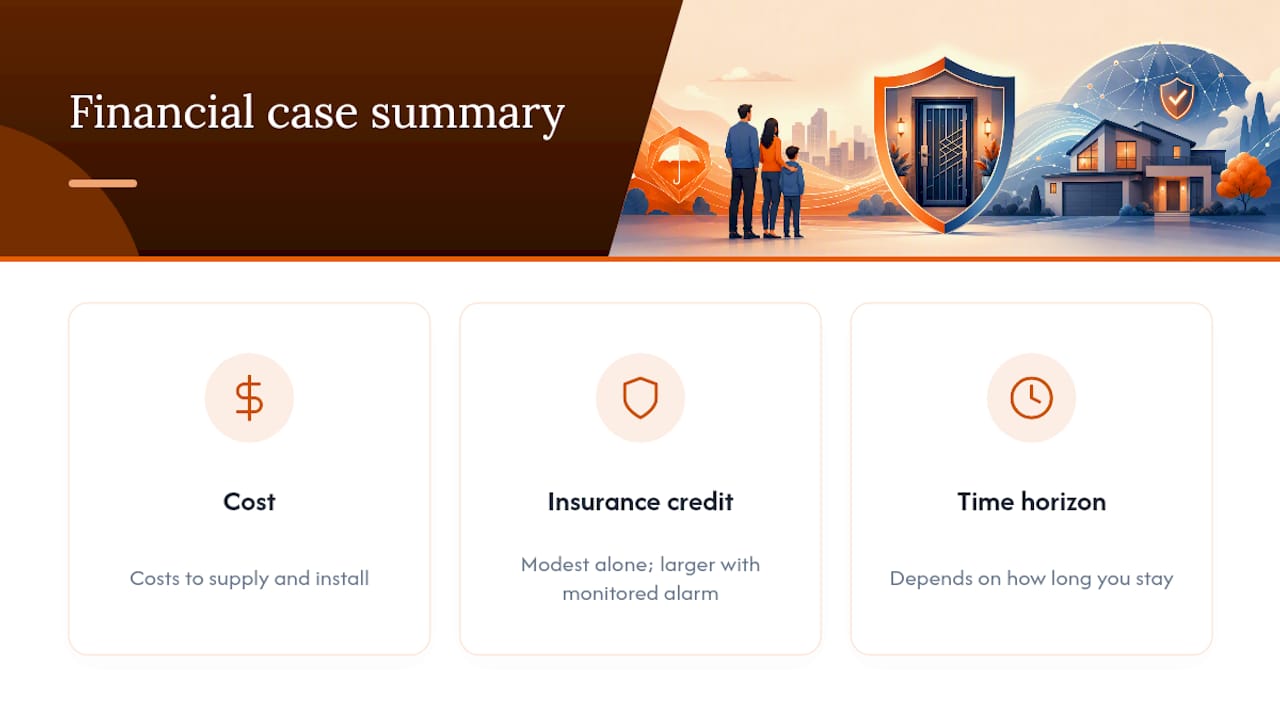
The financial case depends on three variables: what the door costs to supply and install, what discount your insurer applies, and how long you plan to stay in the home. The numbers below are indicative ranges for Australian homeowners.
A few things to read carefully in that table. The door-alone discount is modest on its own. The real financial case improves when a security door is part of a broader security upgrade that includes a monitored alarm system, because monitored systems earn larger credits than passive devices alone. Monitored alarm subscriptions often involve monthly fees, so relying solely on insurance discounts to justify monitoring costs may not be financially advantageous. The non-financial value, reduced theft risk and the deterrent effect, is where the real return sits for most homeowners.
Security doors are evaluated alongside other security measures, not as a guaranteed single-item discount. A home with a certified steel door, deadbolts on every entry point, and a monitored alarm presents a meaningfully different risk profile than one with only a door upgrade. That combined profile is where the stacking credits add up.
Installation, paperwork and maintenance that keep the discount valid
A discount earned at installation can be lost if the door is later found to be non-compliant, poorly maintained, or if the insurer’s records are not updated after a change. Professional installation is the foundation.
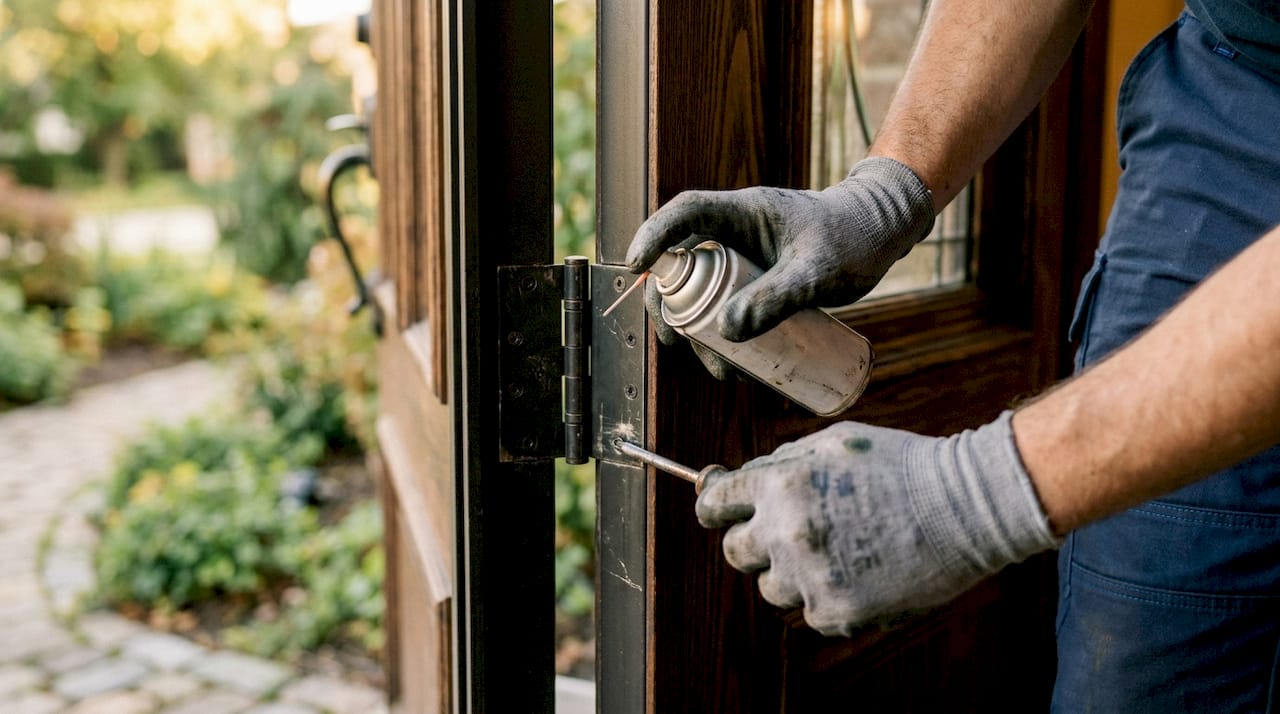
Why professional installation matters:
A licensed installer provides the completion certificate insurers require. They also fit the door to the manufacturer’s specification, which matters for warranty validity and for the product’s test compliance. A door fitted incorrectly, with misaligned locks or inadequate fixings, may not perform to its rated standard even if the product itself is certified. Easterndoors provides installation documentation that meets insurer verification requirements, including product serial numbers and installer credentials.
Maintenance checklist to preserve eligibility:
- Lubricate hinges and lock mechanisms every six months with a dry or silicone-based lubricant.
- Check deadbolt alignment and throw length annually; a bolt that doesn’t fully engage is a security failure.
- Inspect the frame for corrosion, warping, or loose fixings, particularly after extreme weather.
- Test any integrated alarm sensors monthly and replace batteries as recommended.
- Keep service receipts as evidence of ongoing maintenance.
Notifying your insurer of changes:
If you replace a door, upgrade the locking, or add monitoring, tell your insurer promptly. A mid-term endorsement costs nothing and ensures the new credit is applied from the date of installation rather than the next renewal. Conversely, if a door is damaged and not repaired, the insurer may treat the qualifying device as no longer in service.
Pro Tip: Store the installer’s contact details, product serial number, and test certificate reference alongside your policy documents. If your insurer requests verification during a claim, having this information immediately available prevents delays.
A quick checklist before buying and when contacting your insurer
Use this as a reference at purchase and at each renewal.
Before you buy:
- Confirm with your insurer which door types, standards, and locking requirements qualify for a discount.
- Ask whether the specific product you are considering meets those requirements.
- Verify the installer is licensed and can provide a completion certificate.
- Check whether the product carries test certification to AS 5039 or an equivalent recognised standard.
At installation:
- Collect the tax invoice and product specification sheet.
- Obtain a written installation certificate with the installer’s licence number and the product serial number.
- Photograph the fitted door, locks, hinges, and frame fixings.
- Note the installation date and keep all documents in one place.
After installation:
- Call your insurer to request a mid-term policy adjustment.
- Submit the invoice, installation certificate, and photographs.
- Ask for written confirmation of the discount applied and the percentage.
- Request an itemised discount schedule on your policy declarations page.
- Declare any monitoring subscription if applicable.
Review the itemised schedule at every renewal. Credits can be dropped or adjusted without notice, and a quick check takes less than five minutes.
Do insurers offer discounts for security doors?
Yes, Australian insurers do offer discounts for security doors, though the credit is rarely labelled as a “security door discount” in isolation. It typically sits within a protective-device or home-security discount category that covers deadbolts, security screens, alarm systems, and similar measures.
The discount ranges are modest for a door alone. Budget Direct’s home-security guidance is one example of an Australian insurer publishing specific qualifying measures and encouraging homeowners to document their security features when requesting a discount.
The key point is that discounts are not automatic. The homeowner must notify the insurer, provide documentation, and confirm the product meets the insurer’s stated requirements. An insurer that has no record of a security upgrade will not apply a credit at renewal.
Which brands and standards do insurers commonly accept?
Insurers don’t typically publish an approved brand list, but they do reference standards and product categories. In practice, the brands most commonly cited in Australian buyer guides and insurer resources are those whose products have been independently tested and carry verifiable certification.
Crimsafe uses a proprietary high-tensile stainless-steel mesh called Scrigard, tested against impact, knife shear, and jemmy resistance. The product carries test documentation that installers can provide to insurers.
Amplimesh produces stainless-steel security screens tested to Australian standards, with a range of frame and mesh configurations. Their products are available through licensed installers who supply completion certificates.
SecureView offers a woven stainless-steel mesh system with a three-sided locking mechanism, tested to AS 5039. The SecureView vs Crimsafe comparison on the Easterndoors site covers the technical differences in detail.
Eastern Security Doors supplies custom-made aluminium, steel, and stainless-steel security doors and screens, with professional installation and full documentation. Their steel door range covers options from standard residential to heavy-duty configurations.
For any brand, the insurer’s interest is in the test evidence and installation certificate, not the brand name itself. A product from any of these manufacturers, professionally installed and documented, is more likely to qualify than an uncertified product from an unknown supplier, regardless of how it looks.
Limitations and exclusions on security door discounts
Several scenarios commonly result in a discount being denied or withdrawn, and understanding them before you spend is worthwhile.
Door type exclusions. Basic aluminium screen doors, standard hollow-core timber doors, and decorative security grilles without certified locking generally do not qualify. The CHOICE buyer guide notes that low-cost aluminium screen doors around $250–$350 are unlikely to meet insurer standards for a discount credit.
Self-installation. Many insurers require professional installation as a condition of the discount. A door fitted by the homeowner, even if the product itself is certified, may not qualify because there is no installation certificate from a licensed tradesperson.
Incomplete coverage. Some insurers require deadbolts on every external door, not just the front door. A single certified security door on the front entry while other doors remain unsecured may not satisfy the insurer’s full-property requirement.
Adding more devices beyond that cap produces no additional financial benefit, though it still improves physical security.
Monitoring subscription costs. If a monitored alarm is added primarily to increase the insurance credit, the subscription cost can outweigh the saving. NerdWallet’s guidance on home insurance discounts specifically flags this: compare the total cost of monitoring against the actual dollar saving before committing.
Policy type differences. Building-only policies, contents-only policies, and combined home-and-contents policies may treat security device credits differently. Confirm which policy type the discount applies to and whether it affects both building and contents components.
Insurer-specific exclusions. Some insurers exclude certain postcodes, property types (e.g., rental properties, strata-titled units), or door configurations from their protective-device discount programmes. Always check the Product Disclosure Statement for exclusions specific to your situation.
What installers know that homeowners often don’t
The gap between a security door that looks the part and one that actually satisfies an insurer’s requirements is almost always a documentation gap, not a product gap. From an installer’s perspective, the most common reason a homeowner misses out on a discount is that they didn’t ask for the right paperwork at the time of installation.
Homeowners often raise two objections before committing to a certified security door: cost and aesthetics. On cost, the conversation usually shifts once the insurance credit is factored in alongside the reduced theft risk. On aesthetics, the range of custom finishes, mesh patterns, and frame profiles available from reputable installers means a security door doesn’t have to look institutional. Crimsafe, Amplimesh, and SecureView all offer configurations that suit contemporary Australian homes, and custom-made steel doors can be finished to match almost any exterior palette.
What installers already supply, and homeowners should always request, is a written completion certificate with the product serial number, the installer’s licence number, and the installation date. Reputable installers also retain a copy of the manufacturer’s test report for the specific product installed. When an insurer requests verification, having these documents ready reduces the process to a single email rather than a weeks-long back-and-forth.
The practical observation from the installation side is that insurers accept documentation from reputable installers without question when it is complete and specific. Vague receipts, missing serial numbers, or undated photographs are what slow claims down. Getting the paperwork right at installation costs nothing extra and saves considerable frustration later.
Easterndoors: custom security doors with insurance-ready documentation
Easterndoors supplies custom-made aluminium, steel, and stainless-steel security doors and screens for residential properties across Melbourne, with professional installation and the full documentation package insurers need: itemised tax invoice, installation certificate with licence number, product serial numbers, and manufacturer specification sheets.
For homeowners who want a security upgrade that is both physically effective and insurer-verified from day one, Easterndoors offers on-site measurement consultations and can confirm in advance whether a chosen product is likely to meet your insurer’s qualifying standards. The full door and screen range covers aluminium, steel, and stainless-steel options at a range of price points, with custom finishes to suit any home exterior. To book a consultation or request an insurance-compliance checklist, contact Easterndoors directly through the website.
Sources
- Protective Device Insurance Discount – Essential (2026)
- Homeowners Insurance Discounts That Lower Your Premium | Insurance Geek
- How to Get Homeowners Insurance Discounts – NerdWallet
- What to know before buying a security screen door
- Home Security Tips to Protect Your Home from Break-Ins
This article is general information, not a substitute for advice from a qualified financial advisor. Consult a qualified financial professional about your own circumstances before acting on anything here.