Front door security is the practice of combining reinforced materials, certified hardware, and layered defensive features to protect a home’s primary entry point from forced entry and unauthorised access. Most homeowners focus on the lock, but the lock is rarely where a forced entry succeeds. The weakest points are almost always the door frame, the strike plate, and the hinges. A well-designed security system treats the entire doorset as a single unit, not a collection of independent parts. Standards like ANSI Grade 1 and PAS 24 reflect this thinking by certifying the door slab, frame, locks, hinges, and glazing together. The WIDE principle (Window locks, Indoor lights on timer, Door deadlocks, and External lights on sensors) makes a home 49 times more protected from burglary than a home with no security measures at all. That figure alone makes the case for a layered approach.
What are the core components of front door security?
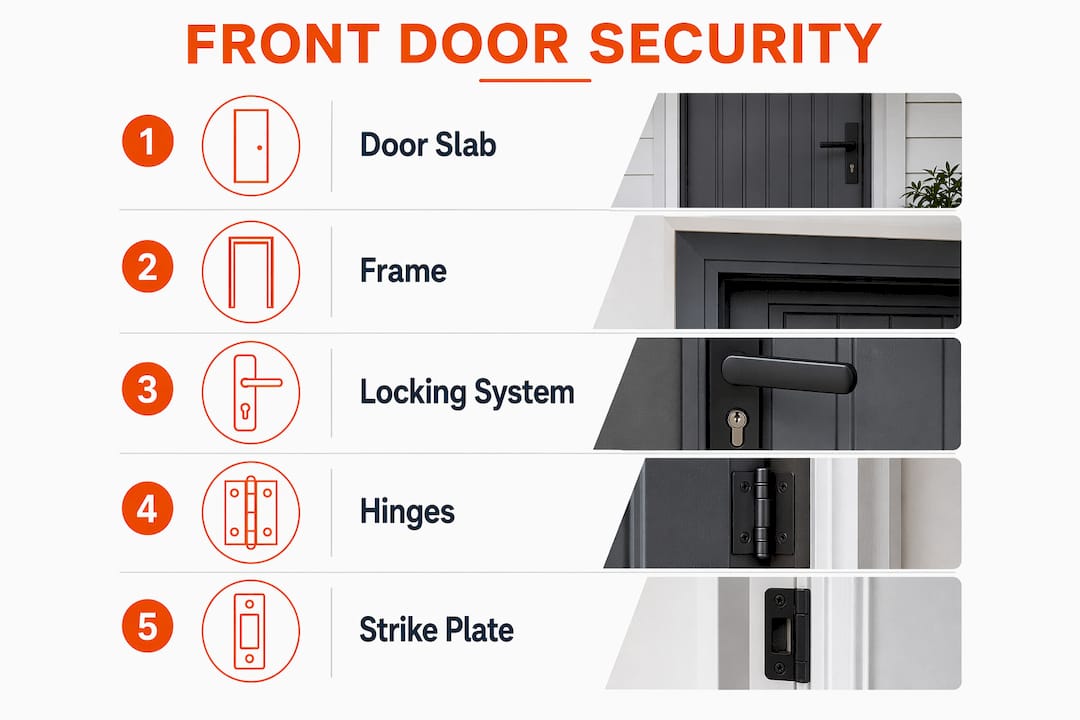
A secure front door depends on five integrated elements: the door slab, the frame, the locking system, the hinges, and the accessories. Weakness in any one of these undermines the rest.
Door slab materials
The material of the door slab sets the baseline for physical resistance. Steel, aluminium, and fibreglass each offer different trade-offs.
| Material | Strength | Weight | Corrosion resistance | Best suited for |
|---|---|---|---|---|
| Steel | Very high | Heavy | Moderate (needs coating) | Maximum security, high-traffic entries |
| Aluminium | High | Light | Excellent | Coastal homes, modern aesthetics |
| Fibreglass | Moderate | Light | Excellent | Mild climates, decorative finishes |
High-quality steel doors withstand over 1,600 lbs of direct force, outperforming standard residential doors that lack reinforced frames and multi-point locking mechanisms. Steel is the benchmark for forced-entry resistance, but aluminium is a practical choice for Australian coastal conditions where salt air accelerates corrosion.
Locking systems
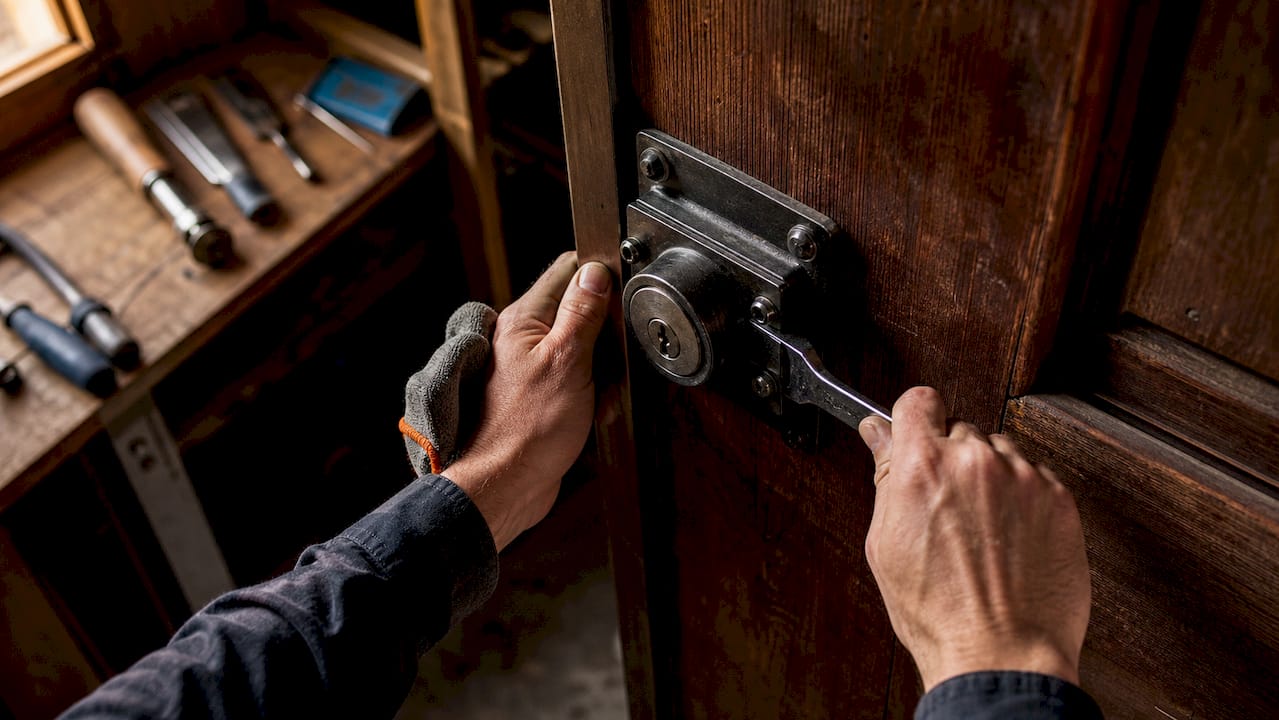
The locking system is the most visible part of home entry security, but its effectiveness depends entirely on the surrounding structure. Multi-point locking systems engage the frame at three or more points simultaneously, distributing force across the entire doorset rather than concentrating it at a single bolt. Deadbolts certified to ANSI Grade 1 or PAS 24 standards are tested to resist forced entry as part of a complete door system, not as standalone hardware. Substituting a certified lock into a non-certified frame does not produce a certified result.
Frames, strike plates, and hinges
The frame and strike plate are where most forced entries actually occur. A standard strike plate held by 1-inch screws pulls away from the frame with a single kick. Replacing those screws with 3-inch hardened steel screws that reach the wall stud significantly increases resistance to forced entry. On the hinge side, non-removable hinge pins and security tabs prevent a burglar from lifting the door off its hinges even when the pins are on the exterior.
Accessories that add a layer of protection
- Security screens: High-tensile stainless steel mesh screens add a physical barrier without blocking airflow or light.
- Reinforced glazing: Laminated or toughened glass panels resist shattering under impact.
- Letterplate restrictors: Prevent tools or hands from reaching through the letterplate to manipulate the lock.
- Door viewers: Wide-angle viewers let you identify visitors without opening the door.
How to harden your front door against forced entry
Physical hardening targets the specific points a burglar will attack first. The frame and door jamb fail before the lock in the vast majority of forced entries. Poor door frame condition, including rotten timber, gaps, or weak anchorage, renders even the most expensive lock ineffective. Addressing the frame is the single highest-return investment in front door security.
Follow these steps to harden your entry door systematically:
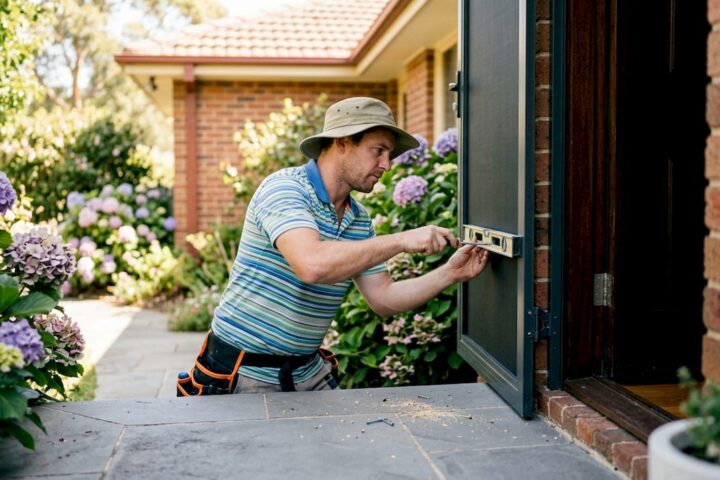
- Inspect the door frame. Check for rot, gaps, or movement when the door is closed. A frame that flexes under hand pressure will fail under a kick.
- Upgrade the strike plate. Replace the standard plate with a heavy-duty steel strike plate and install 3-inch hardened screws that penetrate through the frame into the wall stud.
- Add a door reinforcement plate. A wrap-around steel reinforcement plate covers the lock area and distributes kick force across a wider surface.
- Fit anti-pry strips. These steel strips run along the door edge and prevent a crowbar from gaining purchase between the door and the frame.
- Seal door gaps. Gaps wider than a few millimetres allow a crowbar to be inserted. Use door edge seals or rebate stops to close them.
- Apply security film to glass panels. Security film holds shattered glass in place, preventing quick access through a broken pane.
- Upgrade hinge security. Install hinges with non-removable pins or add security bolts to the hinge side of the door.
Pro Tip: When fitting a new strike plate, use a minimum of four screws, not two. The additional anchor points make it significantly harder to kick the plate free from the frame.
PAS 24 certifies the entire doorset as a unit, including the frame, hinges, slab, and hardware. Swapping out any certified component for a non-certified alternative can void the certification. If you are purchasing a new security door, confirm that the full doorset carries the certification, not just the lock cylinder.
What role do smart technology and visible deterrents play?
Physical barriers stop a determined attacker. Visible deterrents stop most attackers before they try. 83% of burglars check for visible security indicators such as alarm systems or cameras before attempting a break-in. A video doorbell or alarm panel visible from the street changes the risk calculation for a would-be intruder.
Smart technology adds a second layer that physical hardware alone cannot provide:
- Smart locks with auto-lock features eliminate the risk of forgetting to lock the door. Biometric access and temporary codes remove the need to share physical keys with tradespeople or guests.
- Video doorbells record activity at the entry point and send real-time alerts to your phone. The camera housing itself acts as a deterrent, even when no one is home.
- Motion-activated lighting removes the cover of darkness around the entry. Bright, sudden illumination discourages loitering and makes the property less attractive as a target.
- Alarm systems with entry sensors alert you and monitoring services the moment the door is opened or the frame is struck.
Layered defence combining a high-security door, motion-activated lighting, smart cameras, and reinforced strike plates creates a barrier that deters criminals more effectively than any single measure. The combination matters because each element covers a gap the others leave open.
Pro Tip: Position your video doorbell at chest height rather than above the door frame. This angle captures faces clearly and makes the camera more visible to visitors approaching the door.
How do you balance security with style and curb appeal?
Security and aesthetics are not in conflict. The best front door security ideas work with your home’s design, not against it. Australian homes range from Federation-era brick to contemporary rendered facades, and there is a security door or screen to complement each style.
Aluminium security doors offer the widest range of powder-coat colours and profile designs. A door finished in Dulux Monument or Colorbond Basalt reads as a design feature, not a security measure. Steel doors carry a more substantial visual weight that suits contemporary and industrial-style homes. Stainless steel mesh screens preserve the look of a traditional timber door while adding a physical barrier that is nearly invisible from a distance.
Custom security doors allow you to choose the right door for both your security requirements and your architectural style. Decorative laser-cut panels, heritage grille patterns, and slim-profile frames all meet security standards while contributing to kerb appeal. The key is to select a product that is certified to the relevant standard first, then choose the finish and design within that certified range.
Smart locks integrate cleanly into a stylish entry. Slim-profile deadbolts with touch-pad or Bluetooth activation look no different from a standard lever set. Concealed hinges remove visible hardware from the exterior face of the door entirely. The result is an entry that looks considered and well-designed while meeting a high standard of protection.
Pro Tip: Ask your security door supplier for a physical sample of the powder-coat finish before ordering. Colours read differently on a small chip than on a full door panel in natural light.
Key takeaways
Effective front door security requires reinforcing the entire doorset, including the frame, hinges, and strike plate, not just upgrading the lock.
| Point | Details |
|---|---|
| Treat the doorset as a system | Frame, hinges, slab, and locks must all meet the same security standard to be effective. |
| Frame reinforcement is the priority | Replacing short screws with 3-inch hardened steel screws into wall studs is the highest-return upgrade. |
| Visible deterrents reduce risk | 83% of burglars check for cameras and alarms before attempting entry, making visibility a genuine barrier. |
| Certification covers the full unit | ANSI Grade 1 and PAS 24 certify complete doorsets; swapping components can void the rating. |
| Style and security are compatible | Powder-coat finishes, laser-cut panels, and slim smart locks deliver protection without compromising appearance. |
What most homeowners get wrong about securing their front door
The most common mistake I see is treating the lock as the whole solution. Homeowners spend significant money on a high-grade deadbolt and then leave it set in a frame held together by 1-inch screws and ageing timber. The lock holds. The frame does not. That is exactly how most residential break-ins succeed.
The second mistake is neglecting maintenance. A door frame that was solid five years ago may have developed rot, movement, or gaps since then. Regular inspection, every six to twelve months, catches these problems before they become vulnerabilities. Check the frame for flex, look for daylight around the edges when the door is closed, and test that the lock engages cleanly without lifting or dropping the handle.
The third mistake is treating visible deterrents as optional extras. A camera or alarm panel that is clearly visible from the street changes a burglar’s decision before they reach the door. Physical hardening and visible deterrents work together. One without the other leaves a gap.
For Australian homes specifically, the combination of a certified aluminium or steel security door, a reinforced frame, and a video doorbell covers the three most common points of failure. Professional installation matters here because a correctly fitted door and frame performs very differently from the same products installed without proper alignment and anchoring.
— MYBMC
Easterndoors security doors: built for protection and style
Choosing a security door is a significant decision, and getting the specification right from the start saves time and money.
Easterndoors supplies and installs custom-made aluminium, steel, and stainless steel security doors across Melbourne, with a focus on matching each product to the homeowner’s security requirements and architectural style. Every door is manufactured to order, with a fast turnaround and professional installation included. The team provides detailed consultations so you get the right door for your entry, not a generic off-the-shelf product. View the full security door range to see available materials, finishes, and designs. For homeowners in Melbourne’s eastern suburbs, Easterndoors also offers local installation services with experienced fitters who understand the specific requirements of the region.
FAQ
What is the weakest point of a front door?
The door frame and strike plate are the weakest points in most residential entries. Forced entry typically succeeds by splitting the frame rather than breaking the lock.
What locks meet Australian security standards?
Deadbolts certified to ANSI Grade 1 or PAS 24 standards are tested to resist forced entry as part of a complete doorset. Look for certification on the full door system, not just the lock cylinder.
Do security screens actually stop break-ins?
Front door security screens made from high-tensile stainless steel mesh resist cutting and impact. They add a physical barrier that slows entry and increases the risk of detection for an intruder.
How do I secure my front door without replacing it?
Upgrade the strike plate with 3-inch hardened screws into the wall stud, add anti-pry strips along the door edge, fit a door reinforcement plate around the lock, and install a video doorbell for visible deterrence.
Are smart locks as secure as traditional deadbolts?
Smart locks certified to ANSI Grade 1 offer the same physical resistance as a standard deadbolt, with the added benefit of auto-lock, access logs, and temporary codes that reduce the risk of key duplication or loss.