The best way to secure French doors is a custom-made security screen system fitted directly over the existing door opening, combining a reinforced aluminium or steel frame, high-tensile stainless steel mesh, and a three-point locking mechanism. Off-the-shelf options rarely account for the unique dimensions and inswing/outswing configuration of French doors, which is why a professional measure and custom manufacture is the recommended starting point.
At a glance:
- Security: Multi-point locking and heavy-duty mesh resist forced entry far better than standard door hardware alone
- Airflow: Security screens let you keep doors open for ventilation while maintaining a physical barrier
- Visibility: Low-profile stainless mesh preserves sightlines and natural light
- Aesthetics: Powder-coated frames in custom colours integrate with any home exterior
- Warranty: Professional installation comes with written frame, mesh, and workmanship warranties
To get the right fit for your French doors, arrange a free measure and quote with Easterndoors before comparing any further.
Table of Contents
- What styles of French door security screens can you choose?
- Which mesh and frame materials actually hold up?
- What hardware actually stops forced entry on French doors?
- How do you keep airflow without letting insects in?
- What does a French door security screen cost in Australia?
- How does the measure-to-install process work?
- How do you choose the right supplier?
- Why Easterndoors is recommended for French door security screens
- Key takeaways
- Why custom fit matters more than you might think
- Easterndoors: free measure and quote for French door security screens
- Useful sources and further reading
What styles of French door security screens can you choose?
French doors come in a wider variety of configurations than most homeowners realise, and the screen style needs to match the door’s swing direction, leaf count, and frame clearance.
Common styles:
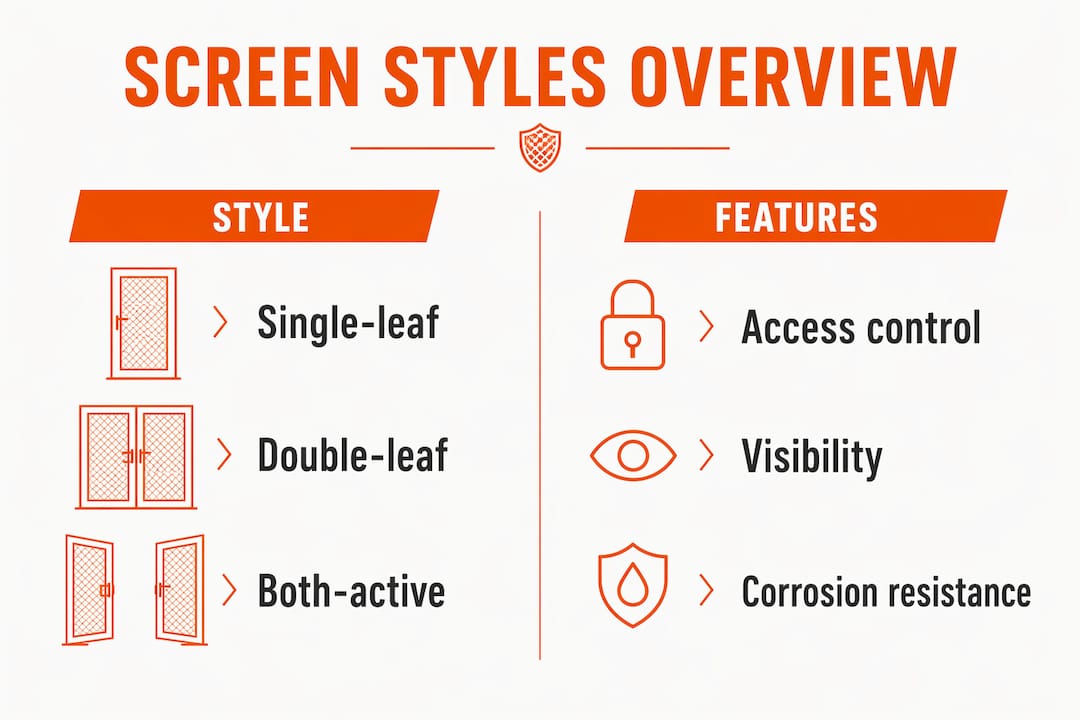
- Hinged double-leaf (active + passive): The most common format. One leaf swings freely; the other is held by flush bolts at the top and bottom. The security screen mirrors this arrangement, with an astragal overlap at the centre seam to eliminate the gap between leaves.
- Double-leaf, both active: Both leaves swing open independently. Requires a coordinated locking system on each leaf and a well-engineered central overlap.
- Sliding or retractable screens: Suited to wider openings or where a hinged screen would obstruct a pathway. Security-grade sliding screens use heavier track systems than standard fly screens.
- Fixed panel or sidelight screens: Used alongside French doors where fixed glass panels sit adjacent to the door opening. These are typically non-opening but use the same mesh and frame specification as the door screen.
Frame finishes run from standard powder-coated aluminium in white, black, bronze, and grey through to painted steel and stainless trim options. The finish affects both corrosion resistance and how well the screen integrates with the door’s existing hardware and colour scheme. For homes with aluminium security doors in Melbourne, matching the frame profile and colour is straightforward because the same extrusion profiles are used across the range.
| Style | Best for | Price band | Visibility | Corrosion resistance | Pet-proofing | BAL/fire rating |
|---|---|---|---|---|---|---|
| Hinged double-leaf | Standard French door openings, high traffic | Mid-range | Good with fine mesh | Good (316 option available) | Yes (heavy mesh) | Available on request |
| Both-active double-leaf | Entertaining, wide access | Premium | Good | Good (316 option available) | Yes | Available on request |
| Sliding/retractable | Wide openings, minimal obstruction | Mid to premium | Excellent | Moderate | Limited | Rarely |
| Fixed sidelight panel | Adjacent glass panels, perimeter security | Budget to mid | Good | Good | N/A | Available on request |
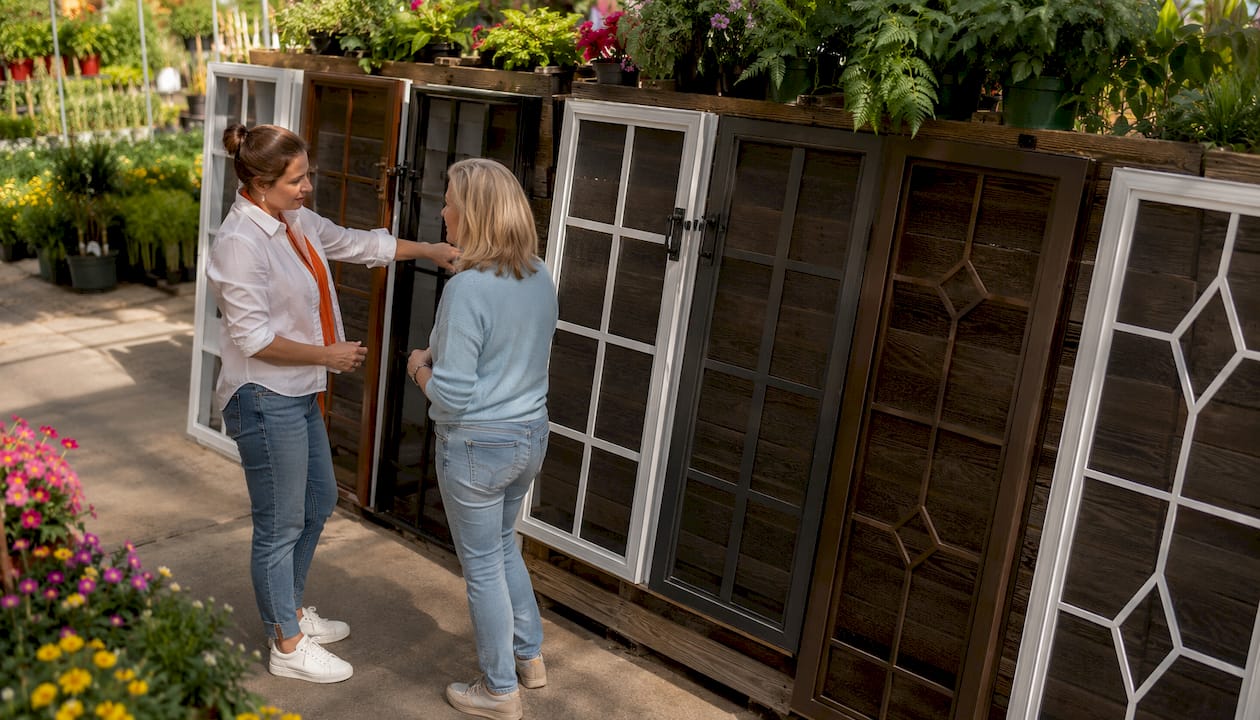
For high-traffic entertaining spaces, a both-active double-leaf system gives full-width access when you need it and a secure, locked barrier when you do not. Pet owners are better served by a hinged system with heavier-gauge mesh, which resists scratching and pushing far better than a retractable screen.
Which mesh and frame materials actually hold up?
Mesh and frame choice determines how long a security screen performs, particularly in coastal or bushfire-prone areas. The differences between grades are meaningful, not just marketing.
Mesh types:
- 316 marine-grade stainless steel: The preferred choice for coastal homes. Installers commonly recommend 316 mesh for its superior corrosion resistance and high tensile strength. It handles salt air without pitting or staining over time.
- 304 stainless steel: Suitable for inland locations. Slightly less corrosion-resistant than 316 but still security-rated and widely used in metropolitan areas away from the coast.
- Low-visibility fine stainless: A finer weave that reduces the visual impact of the screen from inside the home. Maintains security rating but may have slightly lower airflow than a standard weave.
- Perforated aluminium: Provides privacy and some security, but generally not rated to the same forced-entry resistance as woven stainless. Better suited to privacy screens than primary security applications.
- Standard fly/insect mesh: Fibreglass or aluminium insect mesh is not security-rated. It keeps insects out but offers no meaningful resistance to forced entry.
Frame materials:
- T6 extruded aluminium: Lightweight, corrosion-resistant, and paintable. The most common frame material for residential security screens. Holds its shape well under impact when properly anchored.
- Steel: Heavier and more rigid than aluminium. Used where maximum frame strength is required. Requires a quality powder coat or paint finish to prevent surface rust, particularly in coastal zones.
- Stainless steel frame: The premium option for coastal or high-humidity environments. Pairs naturally with 316 mesh for a fully corrosion-resistant assembly.
For bushfire-prone areas, some screen systems can be specified to assist with ember resistance under Australian BAL (Bushfire Attack Level) requirements. An ember-resistant screen uses a finer mesh aperture to block wind-driven embers, which can reduce ignition risk at the door opening. Ask your installer whether their product meets the relevant BAL specification for your property’s rating.
What hardware actually stops forced entry on French doors?
The weakest point on most French doors is not the glass or the deadbolt. It is the central seam where the two leaves meet. Engineered astragal overlaps, flush bolts anchored into the header and sill, and three-point locking systems are the combination that converts two independent door leaves into a single rigid barrier.
Hardware to insist on:
- Three-point or multi-point locking: Engages the frame at the top, centre, and bottom of the door simultaneously. A single deadbolt at the centre leaves the top and bottom of the active leaf free to flex under impact.
- Flush bolts on the passive leaf: The inactive door leaf must be anchored at the header and sill with heavy-duty flush bolts that throw at least 19mm into a metal receiver. Shallow or plastic receivers fail under sustained force.
- Reinforced astragal/overlap: The central overlap strip between the two leaves must be mechanically fastened, not just clipped. A well-designed astragal eliminates the gap that allows a pry bar to be inserted between the leaves.
- Security hinges: Non-removable hinge pins or security hinge studs prevent the hinge from being knocked out on outswing doors. For inswing configurations, the hinge is protected by the frame, but the fixing screws must reach structural framing, not just the door jamb casing.
- Mechanical fastenings: Mesh mechanically fastened to the frame and the frame through-bolted into structural framing resists blowout under impact. Pressure-fit or spline-retained mesh can be pushed out without breaking the frame.
- Isolation layers: Where stainless mesh meets an aluminium frame, an isolation layer prevents galvanic corrosion that would otherwise degrade the fixing points over time.
Trust signals worth asking for:
- Australian-made frames with documented specifications
- Marine-grade 316 mesh confirmation in writing
- Written warranty covering frame, mesh, and installation workmanship
- On-site measure and professional installation (not a drop-ship kit)
A note on glass: A security screen adds a physical outer barrier, but the French door’s glass panels remain a vulnerability if left unaddressed. Laminated or impact-resistant glass, or a quality security window film, is worth considering alongside the screen installation for a fully layered approach.
How do you keep airflow without letting insects in?
Security-grade stainless mesh allows considerably more airflow than a solid door or a perforated aluminium panel, while still blocking insects when the weave is fine enough. The trade-off is that a very fine weave reduces both airflow and visibility slightly compared with a standard security weave.
Practical options:
- Standard security weave: Blocks most insects and allows good airflow. A 12×12 woven stainless weave, for example, is fine enough to exclude most flying insects while maintaining reasonable air movement through the opening.
- Fine low-visibility mesh: Slightly finer aperture, better insect exclusion, marginally reduced airflow. The better choice when the screen faces a garden or outdoor entertaining area where insect pressure is high.
- Layered approach: Combining a security-rated outer screen with an internal retractable fly screen gives you both the forced-entry resistance of the stainless outer layer and the very fine insect exclusion of a dedicated fly screen. This is the most effective solution when both priorities are non-negotiable.
Design choices that preserve sightlines without sacrificing strength include narrow frame profiles and low-visibility mesh. A thinner frame section reduces the visual border around the opening, and a fine stainless weave appears almost transparent from a short distance. Both choices are available without compromising the structural integrity of the screen.
Pro Tip: When airflow is a priority, ask your installer for real-world examples of the mesh in use rather than relying on marketing descriptions. A sample panel held up to your door opening gives a far more accurate sense of visibility and air movement than a product brochure.
What does a French door security screen cost in Australia?
Custom French door security screens are priced by configuration, material grade, and installation complexity. There are no universal list prices because every opening is measured individually, but the following bands reflect typical market positioning for professionally installed, custom-made systems in Australia.
Typical price bands:
- Single-leaf hinged screen (budget to mid-range): Standard powder-coated aluminium frame with 304 stainless mesh. Suited to inland locations with a straightforward installation.
- Double-leaf custom system (mid-range to premium): Includes astragal overlap, three-point locking on the active leaf, flush bolts on the passive leaf, and 316 marine-grade mesh where specified. Price increases with frame complexity and locking hardware quality.
- Retractable or sliding systems (premium): Higher-grade track systems, more complex installation, and often a longer lead time. Priced at the top of the range.
What drives the cost up:
- Custom sizing beyond standard door widths or heights
- 316 marine-grade mesh vs 304 (316 carries a material premium)
- Steel or stainless frame vs aluminium
- Three-point locking hardware vs single-point
- Structural anchoring into masonry or steel framing (more labour)
- BAL/ember-rated specification
- Retrofit into an existing frame vs new-build rough opening
What drives the cost down:
- Standard door dimensions that require less custom fabrication
- Inland location (304 mesh is sufficient, lower material cost)
- Straightforward timber framing for anchoring
An itemised quote that separates materials, hardware, labour, and warranty gives you the clearest basis for comparing suppliers. A detailed, line-by-line estimate lets you identify where a cheaper quote is cutting corners rather than genuinely offering better value. Always request an on-site measure before accepting any quote, because a price given without a site visit cannot account for the specific clearances, thresholds, and framing conditions of your doors.
Lead time note: Custom manufacture typically takes several weeks from confirmed order to installation. Complexity, finish selection, and current workshop load all affect this. Ask for a written timeline at the quoting stage.
How does the measure-to-install process work?
The process for a professionally installed custom French door security screen follows a consistent sequence, and knowing what to expect at each stage makes the whole experience straightforward.
- Free measure and quote: A technician visits the site, takes precise measurements of the door opening, assesses the framing, swing direction, threshold conditions, and existing hardware. A written, itemised quote follows.
- Finish and hardware selection: You choose the frame colour, mesh grade, locking hardware, and any additional options (pet mesh, BAL rating). This is confirmed before manufacture begins.
- Custom fabrication: The frame and mesh assembly are manufactured to the exact dimensions of your opening. Custom fabrication and professional installation are what distinguish a security screen from an off-the-shelf product.
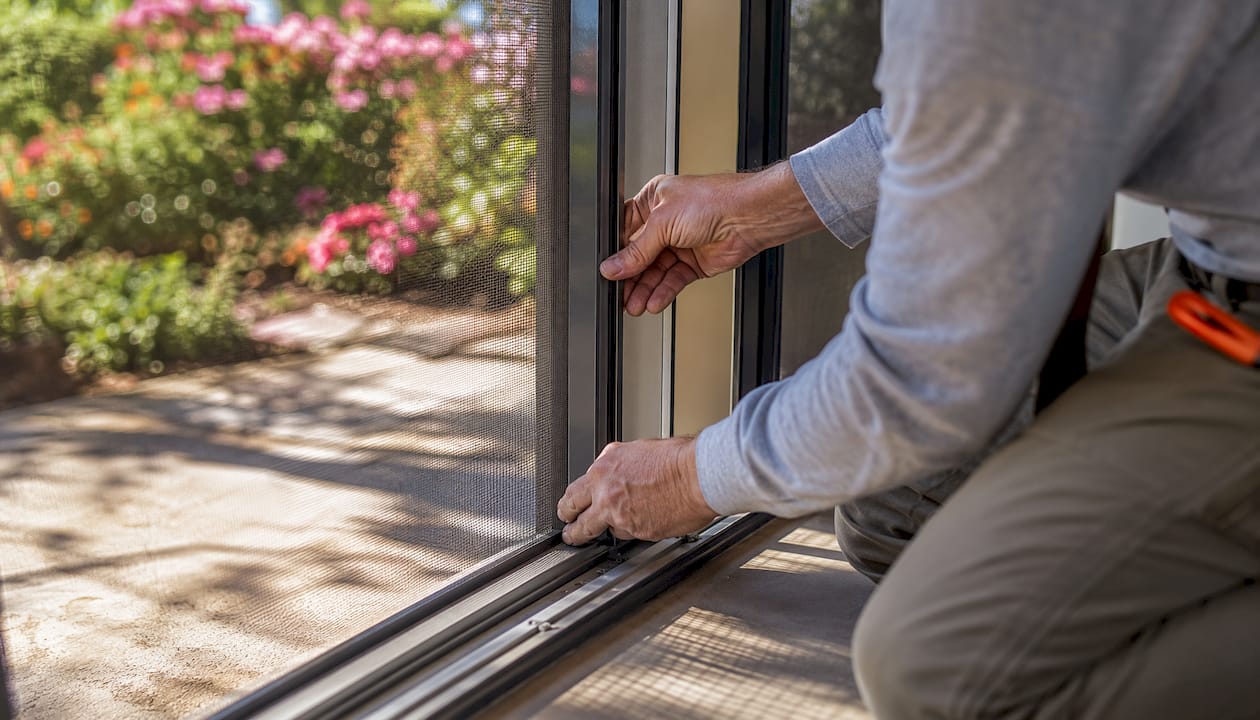
- Scheduled installation: A professional installation team fits the screen, anchors the frame into structural framing, aligns the locking hardware, and adjusts the hinges and astragal for correct operation.
- Final inspection and handover: The installer demonstrates the locking operation, checks all fixing points, and provides written warranty documentation.
What to have ready for the measure appointment:
- Clear access to both door leaves and the full frame perimeter
- Note of any existing thresholds, step-downs, or raised sills
- Handle and lock positions on the existing doors
- Any clearance restrictions (furniture, architraves, or adjacent walls)
- Preferred swing direction for the screen (typically opposite to the door)
Warranty terms vary by supplier, but a quality installation should include a written warranty covering the frame, mesh, and installation workmanship separately. Hardware warranties from the lock manufacturer are typically documented alongside the installer’s own workmanship guarantee. Get all of this in writing before signing off.
How do you choose the right supplier?
Price is the easiest thing to compare across quotes, but it is rarely the most useful. The questions below give you a structured way to assess suppliers on the factors that actually determine whether your screen performs over the long term.
Questions to ask on the phone or at a site visit:
- Do you conduct an on-site measure before quoting, or do you quote from dimensions I provide?
- What mesh grade do you use, and can you confirm 316 marine-grade stainless in writing?
- What locking system is standard, and does it include three-point engagement?
- How is the mesh fastened to the frame — mechanical fastenings or spline/pressure fit?
- Do you anchor the frame into structural framing, and how do you handle masonry or steel?
- Is the product BAL-rated or ember-resistant, and which BAL level?
- What is the lead time from confirmed order to installation?
- What does the written warranty cover, and for how long?
- Do your own tradespeople install, or do you subcontract?
- Can you show completed examples of French door installations similar to mine?
Red flags to watch for:
- Off-the-shelf sizes only, with no on-site measure offered
- Pressure-fit or spline-retained mesh presented as security-grade
- Vague warranty terms (“covered for defects” with no defined period or scope)
- A quote provided without a site visit
- No examples of completed French door installations available
Quick scoring rubric for comparing three quotes:
| Criterion | What to look for |
|---|---|
| Build quality | Mechanical mesh fastenings, T6 or steel frame, documented mesh grade |
| Security features | Three-point locking, flush bolts on passive leaf, reinforced astragal |
| Warranty and service | Written warranty with defined periods for frame, mesh, and labour |
| Local manufacture | Australian-made frames, local installation team, repair service available |
When choosing the right security door or screen, the supplier who asks the most questions about your specific door configuration is usually the one who will deliver the best result.
Why Easterndoors is recommended for French door security screens
Easterndoors specialises in custom-made security doors and screens for residential properties, with a full service covering design consultation, on-site measurement, manufacturing, professional installation, and ongoing repair and aftercare. Every product is custom-fabricated to the exact dimensions of your door opening, which matters particularly for French doors where standard sizes rarely fit correctly.
What Easterndoors offers:
- Custom design and manufacture of aluminium, steel, and stainless security doors and screens
- Marine-grade 316 stainless steel mesh options for coastal and high-humidity environments
- Three-point locking systems and reinforced astragal configurations for double-leaf French doors
- Professional installation by their own team, with structural anchoring into framing
- On-site measure and written, itemised quote before any commitment
- Repair and aftercare services for installed products, including security screen and fly door repair
- Written warranty covering frame, mesh, and installation workmanship
Easterndoors operates across Melbourne and surrounding suburbs, with completed installations across areas including Ferntree Gully, Vermont, Montrose, and Knox. Their local manufacture and installation model means the same team that builds your screen fits it, which keeps accountability clear and turnaround times shorter than suppliers who outsource either step.
For homeowners ready to move forward, the next step is a free on-site measure and quote. Contact Easterndoors to arrange a time, and receive a written, itemised proposal covering mesh grade, frame specification, locking hardware, installation timeline, and warranty terms.
Key takeaways
Custom-fit French door security screens with marine-grade mesh, three-point locking, and professional installation deliver the most reliable security outcome for Australian homeowners.
| Point | Details |
|---|---|
| Mesh grade matters | Specify 316 marine-grade stainless for coastal areas; 304 is sufficient for inland locations. |
| Three-point locking is non-optional | Single-point deadbolts leave the top and bottom of the active leaf free to flex; three-point engagement closes that gap. |
| On-site measure is required | No quote given without a site visit can account for your door’s specific clearances, thresholds, and framing. |
| Compare itemised warranties | A written warranty that separates frame, mesh, and labour lets you compare suppliers on equal terms. |
| Easterndoors | Custom measure, manufacture, and professional installation across Melbourne, with marine-grade mesh options and written warranties. |
Why custom fit matters more than you might think
The most common failure point on French door security screens is not the mesh tearing or the lock failing. It is a gap. Off-the-shelf screens that do not precisely match the door opening leave clearance at the edges, the top, or the central seam that undermines the entire installation. A determined intruder does not need to break through the mesh if there is enough play at the frame to lever the screen away from the wall.
The central seam on double French doors deserves particular attention. A well-designed astragal and flush-bolt strategy effectively converts two independent door leaves into a single rigid panel. The flush bolts anchor the passive leaf into the header and sill, the astragal overlaps the active leaf, and the three-point lock on the active leaf completes the assembly. Remove any one of those three elements and the seam becomes a weak point again. This is why a stronger deadbolt alone does not solve the problem — the central seam vulnerability requires an engineered response, not just a hardware upgrade.
For coastal installations, the isolation layer between the stainless mesh and the aluminium frame is a detail that separates a long-lasting installation from one that corrodes at the fixing points within a few years. Galvanic corrosion between dissimilar metals is accelerated by salt air, and a screen that looks intact from the outside can have compromised fixings that fail under impact. Specifying isolation layers and marine-grade 316 mesh together is the correct approach for any home within a few kilometres of the coast.
Maintenance is straightforward but worth doing annually. Check hinge pins for play, test the flush bolts for smooth operation, and rinse the mesh and frame with fresh water if the home is in a coastal zone. If the locking hardware feels stiff or the astragal no longer seats cleanly, call for a service before the problem worsens. A well-maintained screen installed correctly will outlast the door behind it.
Easterndoors: free measure and quote for French door security screens
Easterndoors provides a no-obligation, on-site measure and written quote for custom French door security screens across Melbourne and surrounding suburbs. The quote covers laser measurement of your door opening, a recommended specification including mesh grade, frame material, and locking hardware, installation notes specific to your framing type, and full warranty terms in writing.
After accepting a quote, Easterndoors manages the full process from fabrication through to professional installation and final handover. Lead times are kept short through local manufacture, and their repair service means you have ongoing support well after installation day. Whether your French doors face a coastal garden or a suburban backyard, there is a custom security screen solution matched to your opening, your climate, and your budget.
Contact Easterndoors to book your free on-site measure and take the first step toward a properly secured French door opening.
Useful sources and further reading
- French Doors — California Security Screens: Explains the core method of custom fabrication and heavy-grade mesh for securing French door openings while maintaining ventilation.
- French Doors — Got Security Screens: Covers marine-grade 316 mesh recommendations for coastal climates, on-site measure workflows, and itemised quoting advice.
- French and Double Door Security Screens — Boss Security Screens: Detailed installer write-up on astragal overlaps, flush bolts, three-point locking, mechanical fastenings, and ember-resistant options.
- Are French Doors Secure? — Doors and Beyond: Honest assessment of French door vulnerabilities and the role of multipoint locks and laminated glass in closing the security gap.
- How to Make French Doors More Secure — Doors and Beyond: Six methods ranked by cost and effectiveness, from strike plate reinforcement through to multipoint locks and security film.
- Crimsafe Security Screen Doors for French Doors: Manufacturer perspective on combining security mesh with insect protection and the layered screen approach.
- 5 Steps for Enhanced French Door Security — Bob Vila: Practical homeowner guide covering security film, multipoint locks, security bars, and the role of double security screen doors as an outer barrier.
- Barn Doors vs. French Doors — One Day Doors and Closets: Useful comparative perspective on French door configurations and how door type affects security and layout decisions.