A triple lock security door, also called a 3-point lock security door, secures your entry at three points simultaneously: top, centre, and bottom of the door frame. One turn of the key or thumbturn engages all three. For Australian homeowners, that means significantly stronger resistance to forced entry compared with a standard single-centre deadlock, and a much better chance of meeting the performance expectations set out in AS 5039-2023, the current Australian Standard for security screen doors and grilles.
Before you commit to a product, check three things:
- Confirm the door and lock carry AS 5039-2023 compliance documentation, not just a supplier’s verbal assurance.
- Ask whether the quote includes professional installation, since alignment of all three locking points is what makes the system work.
- Request a product datasheet and warranty in writing before signing anything.
Table of Contents
- How a triple-lock mechanism actually works
- Why a triple-lock door is worth it for homes and rental properties
- How triple locks compare with single locks and other systems
- Australian standards and certification: what AS 5039-2026 means for you
- Features, materials, and products available in Australia
- What professional installation involves and how to maintain your door
- How to choose a triple-lock security door: a checklist for buyers
- Why correct installation and calibration matter: the evidence
- Practical next steps for homeowners ready to upgrade
- Key takeaways
- The case for triple locks is stronger than most buyers realise
- Easterndoors: custom security doors, measured and installed in Melbourne
- Sources and further reading
How a triple-lock mechanism actually works
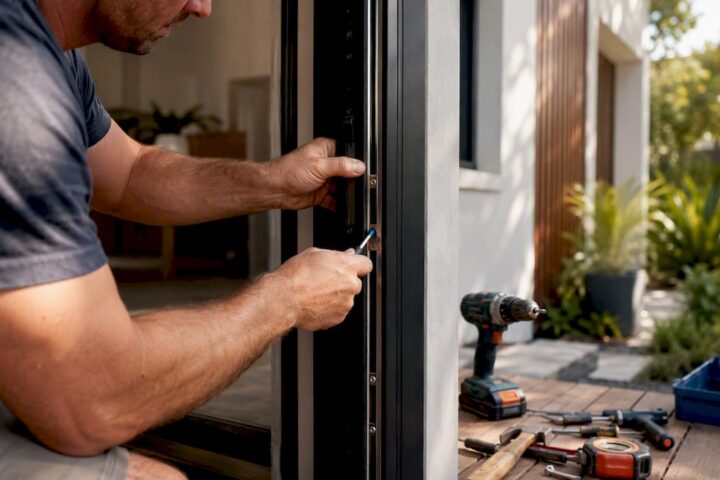
The three locking points are connected by a steel rod or cable running vertically inside the door stile. When you turn the key or operate the snib, the rod moves and simultaneously drives bolts or hooks into strike plates at the top, centre, and bottom of the frame. The door is held along its full height rather than at a single mid-point.
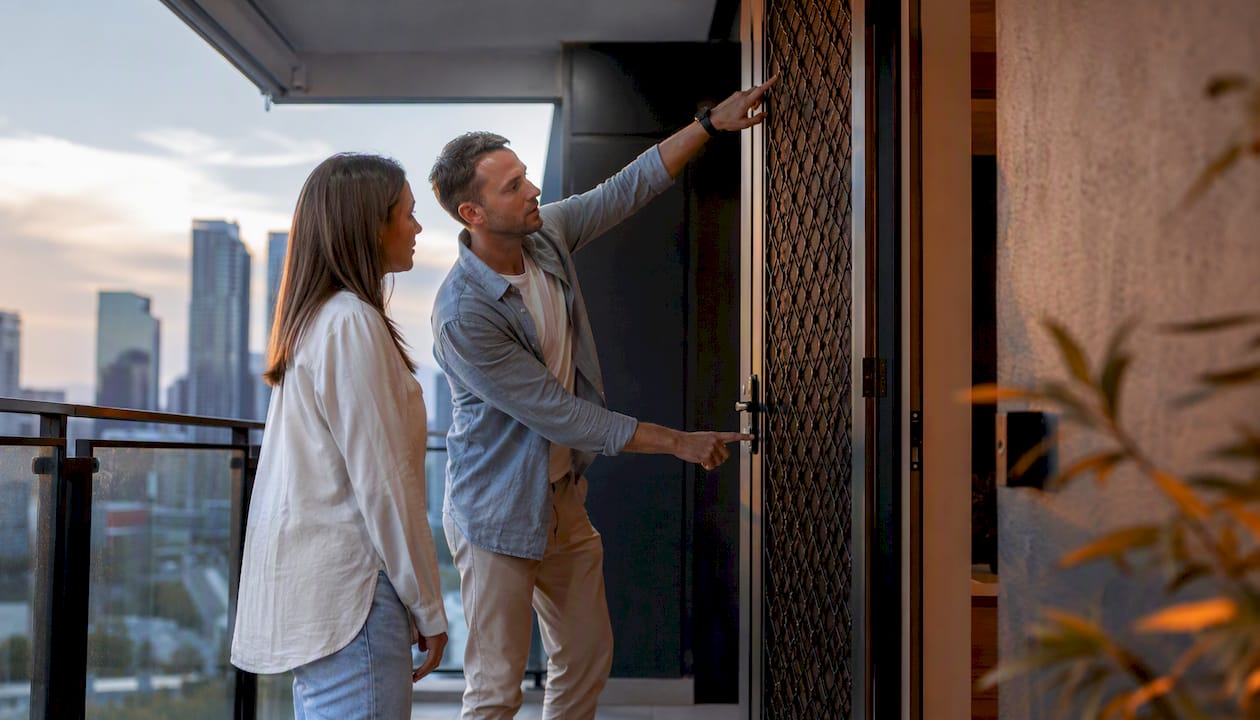
From a user’s perspective, the operation feels no different from a standard deadlock. One action locks or unlocks the door. There is no separate top bolt to throw or bottom bolt to kick down.
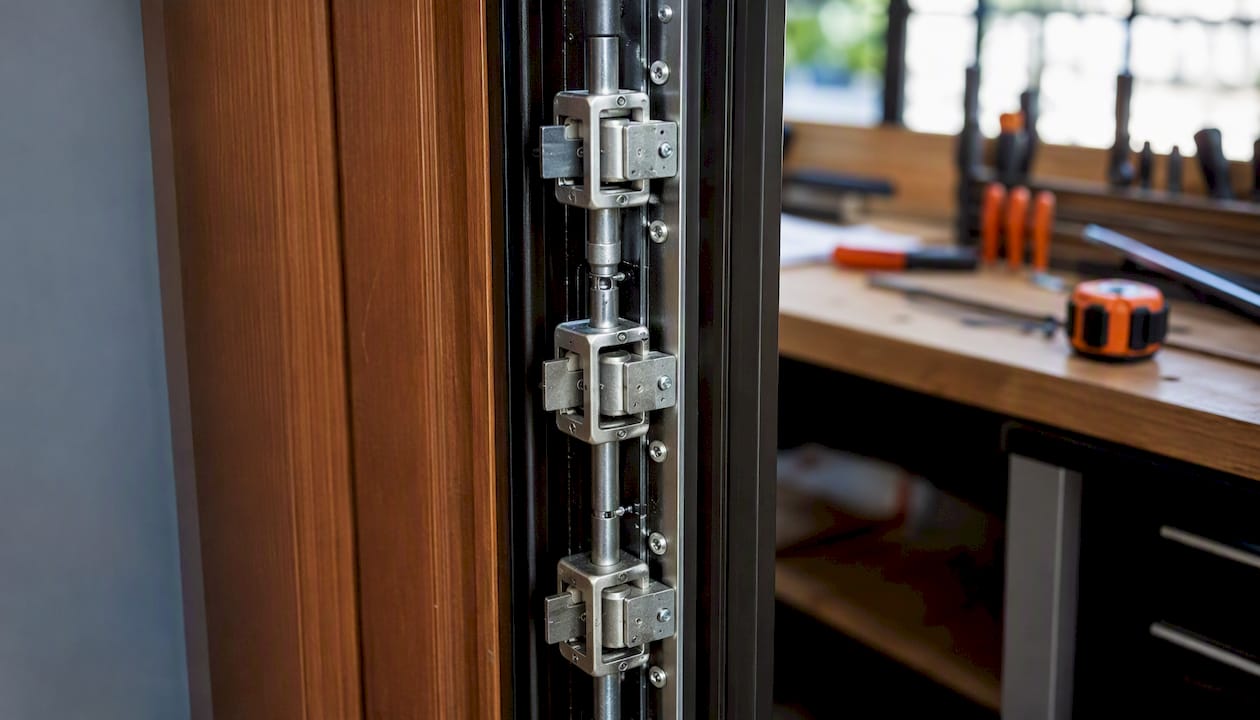
Triple locking works across several door configurations. Hinged security doors are the most common application, but sliding doors can also be fitted with triple-track kits that prevent the panel from being lifted out of its track or levered sideways. French door and stacker configurations are also supported, though the hardware varies by manufacturer. If you have a sliding door, ask your installer specifically about triple-track options rather than assuming a standard hinged-door kit will transfer across.
Why a triple-lock door is worth it for homes and rental properties
The security case for triple locking comes down to load distribution. A single-centre deadlock concentrates all resistance at one point, which means a determined intruder can apply leverage at the top or bottom of the door and twist the frame until the lock gives. Three engagement points spread that load across the full height of the door, making frame twist and prying attacks substantially harder to execute.
Practical advantages for homeowners and property managers include:
- Forced-entry resistance. Prying, levering, and door-twist attacks are all harder when the door is held at three points rather than one.
- Reduced hinge-side failure. Better load distribution means less stress on the hinge side, which reduces the risk of the door warping or the hinges pulling away from the frame over time.
- Insurance and compliance support. Some Australian insurers ask for evidence of security upgrades when assessing claims or setting premiums. A door that meets AS 5039-2023 provides a documented basis for those conversations.
- Single-action convenience. Despite the added security, the user experience is simple: one turn locks all three points. There is no multi-step locking routine to forget at night.
- Retrofit potential. Kitted 3-point lock systems, including Lockwood-compatible options, allow existing door sections to be upgraded without replacing the entire door frame.
For rental properties in particular, the combination of documented compliance and single-action operation is practical: tenants are more likely to use a lock consistently when it is straightforward.
How triple locks compare with single locks and other systems
The most common alternative is a single-centre deadlock, which secures the door at one point only. The table below shows where the two systems differ in ways that matter at purchase time.
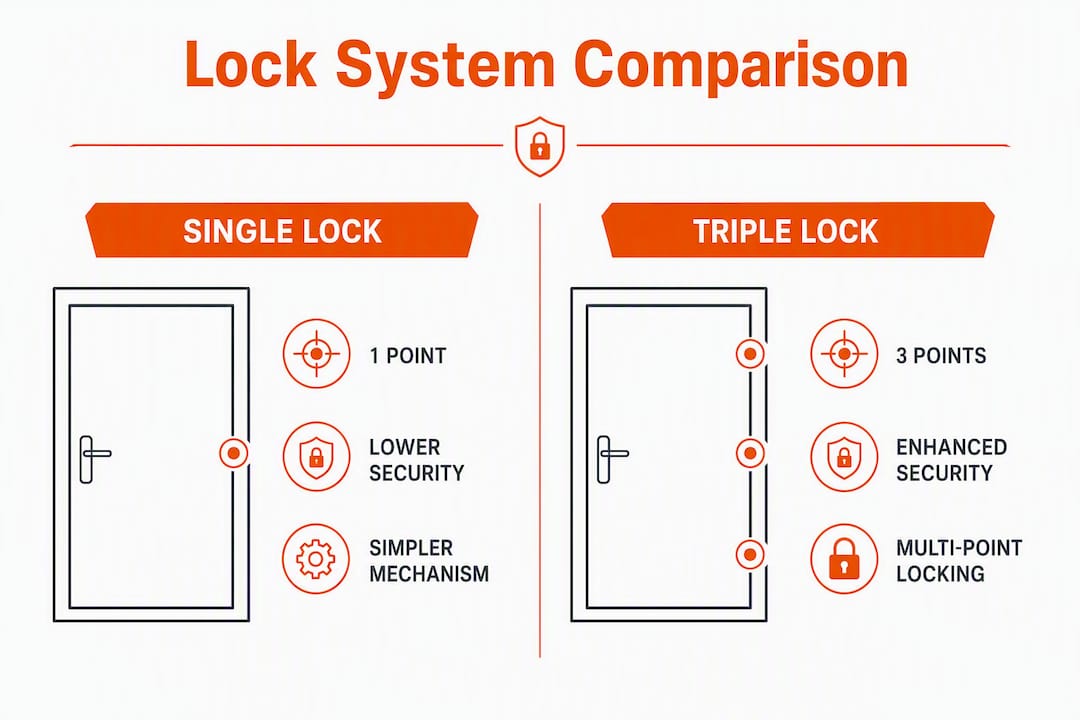
| Feature | Single-centre deadlock | Triple lock (3-point) |
|---|---|---|
| Locking points | 1 (centre) | 3 (top, centre, bottom) |
| Forced-entry resistance | Moderate | High |
| Frame twist vulnerability | Higher | Lower |
| AS 5039-2023 alignment | Possible, but harder to achieve | Designed to support compliance |
| User operation | Single action | Single action |
| Typical cost | Lower | Moderate to higher |
| Retrofit options | Wide | Available (kitted systems) |
Beyond triple locking, some high-security applications use five-point or multi-point systems with additional side bolts. These are common on steel security doors for commercial premises or high-risk residential properties. For most Australian homes, a correctly installed triple-lock system is sufficient; five-point systems add cost and complexity without a proportionate security gain for standard residential use.
Single locks remain appropriate for:
- Internal doors where forced-entry risk is low.
- Secondary or service doors where budget is the primary constraint.
- Situations where an existing single-lock door already meets the insurer’s minimum requirement.
If you are comparing quotes and one supplier offers a single lock while another offers a triple lock at a similar price, the triple-lock option is almost always the better choice for an external entry door.
Australian standards and certification: what AS 5039-2026 means for you
AS 5039-2023 is the current Australian Standard covering the performance requirements for security screen doors and grilles. It sets out testing criteria for impact resistance, knife shear, jemmy attack, and dynamic impact, among others. Compliance is assessed on the complete installed system, not on the lock or mesh in isolation.
Suppliers commonly link triple-lock systems to AS 5039 and AS 5041 testing, but the critical point is that a compliant lock fitted to a non-compliant frame, or installed with poor alignment, will not produce a compliant door. The system must be treated as a whole.
When reviewing quotes or visiting a showroom, ask for the following documents:
- Test certificate or compliance statement referencing AS 5039-2023, issued by the manufacturer or an accredited testing body.
- Product datasheet showing the door, frame, mesh, and lock as a tested assembly.
- Installation compliance statement confirming the installer will fit the system to the manufacturer’s specification.
- Warranty documentation covering both the product and the installation workmanship.
A supplier who cannot produce these documents on request is not in a position to make a credible compliance claim. Verbal assurances are not sufficient when you are relying on the door for security and potentially for insurance purposes.
Features, materials, and products available in Australia
Australian buyers have a genuine range of material and mesh options, and the choice affects both security performance and long-term maintenance, particularly in coastal areas where salt air accelerates corrosion.
Common material options include:
- Marine-grade stainless woven mesh (such as Crimsafe’s high-tensile 304 or 316 stainless mesh): the strongest and most corrosion-resistant option, suited to coastal properties and high-security applications.
- Aluminium sheet and perforated aluminium: lighter and more affordable, with good corrosion resistance for inland locations.
- Diamond grille and bar-style aluminium: traditional appearance, lower mesh-area coverage, suited to heritage or period homes.
Product ranges typically include options like INVISI-GARD and ALU-GARD alongside perforated aluminium, giving buyers a clear cost-to-performance spectrum to work with.
On the hardware side, look for:
- Snib operation that controls all three locking points from inside without a key, which is important for fire-exit compliance.
- Anti-tamper faceplates on the lock body to resist drilling and picking.
- Stainless steel internal rods rather than cables, for durability and resistance to corrosion inside the stile.
- Cylinder options that accept your existing house key, reducing the number of keys you carry.
Crimsafe is one of Australia’s most recognised security screen brands, with a screw-clamp mesh retention system that prevents the mesh from being pushed out of the frame. Lockwood supplies widely used 3-point lock kits compatible with standard door sections and is a common hardware choice among Australian installers. Oz Roller Shutters offers a dedicated triple-lock 3-point lock product for roller shutter and door applications. Easterndoors supplies custom-made security doors in aluminium, steel, and stainless steel across Melbourne, with triple-lock configurations available across the range.
For sliding doors, confirm that the supplier’s triple-lock solution includes a triple-track kit, since the mechanism for a sliding panel differs from a hinged door and requires specific hardware to prevent lifting and lateral bypass.
What professional installation involves and how to maintain your door
Professional installation is strongly recommended by manufacturers and suppliers because the alignment of all three strike plates to the corresponding locking points is what determines whether the system performs as tested. A misaligned strike plate at the top or bottom means that locking point does not engage fully, which reduces the door’s resistance to forced entry and may void the compliance claim.
On site, a professional installer will:
- Measure the rough opening and confirm the frame is square before fitting.
- Set and align the three strike plates to match the rod travel precisely.
- Check that the door closes flush without binding, which affects both security and long-term wear.
- Test the full locking cycle before signing off.
Pro Tip: Ask your installer to demonstrate the full lock cycle in front of you before they leave. All three points should engage smoothly with no sticking or grinding. If the top or bottom bolt requires force, the strike plate needs adjustment.
Routine maintenance is straightforward but worth scheduling:
- Lubricate the lock mechanism and rod every six months using a dry lubricant or manufacturer-recommended product. Avoid WD-40 on lock cylinders, as it attracts dust.
- Inspect hinge pins annually. Security door hinge pins interlock when the door is closed, preventing removal of the door even if external hinges are tampered with. Check that pins are seated correctly and show no signs of corrosion.
- Check rod movement by operating the lock slowly and watching for any hesitation at the top or bottom engagement point.
- Inspect the frame and strike plates for signs of movement, rust, or impact damage, particularly after any attempted break-in or storm event.
Common early warning signs include a lock that requires more force than usual to throw, a door that no longer closes flush, or visible rust on the rod or strike plate hardware. Catching these early avoids a more expensive repair later.
How to choose a triple-lock security door: a checklist for buyers
Use this list when comparing quotes and visiting showrooms. A supplier who can answer all of these points confidently is worth taking seriously.
- AS 5039-2023 compliance. Ask for the test certificate for the complete assembly, not just the lock or mesh in isolation.
- Material and mesh choice. Match the material to your location: marine-grade stainless for coastal properties, aluminium for inland. Consider the right security door for your home based on your specific exposure and budget.
- Lock brand and warranty. Confirm the lock brand (e.g. Lockwood) and ask for the warranty period in writing, covering both the hardware and the installation workmanship.
- Hinge reinforcement. Check whether the door includes security hinge pins or reinforced hinges. Exposed external hinges without security pins are a known vulnerability.
- Fire-exit compatibility. If the door is on a primary egress route, confirm that the snib allows single-action exit from inside without a key.
- Lead time. Custom-made doors typically require a manufacturing lead time. Confirm this upfront so it fits your timeline.
- Price and quote structure. Understand whether the quote covers supply only or supply and installation. A supply-only price looks lower but transfers the alignment risk to you or a third-party tradesperson.
- Questions to ask your installer:
- Which testing body certified this assembly to AS 5039-2023?
- Who carries out the installation, and are they employed by the company or subcontracted?
- What does the warranty cover if the lock fails or the alignment shifts after installation?
- Can the cylinder be keyed to match my existing house key?
- What is the process if I need a service call after installation?
Price ranges for supply-and-install triple-lock security doors in Australia vary by material, size, and supplier. Aluminium options generally sit at the more accessible end of the market, while marine-grade stainless steel doors command a higher price reflecting the material cost and corrosion performance. Always compare supply-and-install quotes on a like-for-like basis, including the same compliance documentation and warranty terms.
Why correct installation and calibration matter: the evidence
The security industry is consistent on one point: a superior lock fitted to a poorly aligned frame does not produce a secure door. Professionals emphasise that the lock, strike plates, and door frame must be treated as one calibrated system, and that no single component guarantees resistance without the others being correctly specified and installed.
A triple-lock door where the top strike plate is even slightly misaligned will not engage that locking point under load. In a forced-entry attempt, the door behaves like a single-lock door at the moment it matters most. Correct alignment is not a finishing detail — it is the mechanism by which the system achieves its tested performance rating.
Easterndoors handles measure, custom manufacture, and professional installation as an integrated service, which means the same team that specifies the door also fits it and verifies alignment before handover. That continuity removes the gap between what a product is rated to achieve and what it actually delivers in your home.
Practical next steps for homeowners ready to upgrade
If you have decided a triple-lock security door is the right direction, the following steps will move you from research to installation efficiently.
- Book a measure and quote. Contact a supplier who offers supply-and-install, not supply only. Bring the installer to the door rather than measuring yourself, since frame squareness affects the fit.
- Request product documentation. Ask for the AS 5039-2023 test certificate, the product datasheet for the complete assembly, and the warranty terms before signing.
- Prepare for the installer visit. Note the door’s rough opening dimensions, photograph the existing lock and hinges, and confirm whether you want the new cylinder keyed to your existing house key.
- Compare quotes on equal terms. Check that each quote includes installation, alignment, and a compliance statement. A lower supply-only price is not comparable to a supply-and-install quote.
- Confirm lead time and installation date. Custom manufacture takes time. Lock in a date that suits your schedule and confirm what happens if the door requires adjustment after installation.
- Ask about after-sales service. A reputable installer will offer a service call if alignment shifts or the mechanism requires adjustment within the warranty period.
Easterndoors offers free measure and quote visits for Melbourne homeowners, with custom manufacture and professional installation handled by the same team.
Key takeaways
A triple-lock security door, correctly specified and professionally installed to AS 5039-2023, is the most practical high-resistance option for Australian residential entry doors.
| Point | Details |
|---|---|
| Triple-lock mechanism | Three locking points linked by an internal rod engage simultaneously with one key turn or thumbturn. |
| AS 5039-2023 compliance | Compliance applies to the complete installed system, not the lock alone; always request the test certificate. |
| Professional installation | Strike plate alignment at all three points is what determines real-world performance; DIY fitting risks voiding compliance. |
| Maintenance schedule | Lubricate the mechanism every six months and inspect hinge pins and rod movement annually. |
| Easterndoors | Supplies custom-made triple-lock security doors in aluminium, steel, and stainless steel across Melbourne, with integrated measure, manufacture, and installation. |
The case for triple locks is stronger than most buyers realise
The conventional wisdom is that any security door with a decent lock is good enough for a standard suburban home. That view underestimates how often forced entry succeeds not because the lock was picked, but because the door was levered at a point the lock did not cover.
A single-centre deadlock leaves the top and bottom of the door effectively unsecured against lateral force. An intruder does not need to defeat the lock; they need to apply enough leverage at the unprotected end of the door to twist the frame until the bolt pulls through. Triple locking removes that option by holding the door at all three points simultaneously.
The other thing buyers underestimate is the installation gap. A well-specified door fitted by someone unfamiliar with the alignment requirements of a 3-point system can perform no better than a single lock. The compliance certificate on the product does not transfer automatically to the installed door. That is why the installer’s track record and the integration of supply and installation matter as much as the product specification itself.
For low-risk internal doors or secondary access points, a triple lock is probably more than you need. But for a front door, a rear entry, or any door that a property manager is relying on to meet a tenancy or insurance requirement, the case for a correctly installed triple-lock system is straightforward.
Easterndoors: custom security doors, measured and installed in Melbourne
Easterndoors designs, manufactures, and installs custom security doors for Melbourne homeowners and property managers, with triple-lock configurations available across the full aluminium, steel, and stainless steel range. Every door is made to measure, which means the frame, mesh, lock hardware, and hinge configuration are specified together rather than assembled from off-the-shelf parts.
The service covers the complete process: an in-home measure and consultation, custom manufacture, professional installation with full alignment verification, and after-sales support if adjustment is needed. For Melbourne homeowners comparing supply-and-install quotes, that integrated approach means one point of contact for compliance documentation, warranty, and any follow-up service.
To get started, request a free measure and quote or visit the Easterndoors showroom to see the material and hardware options in person. Bring your door measurements and any existing lock photos to make the consultation as productive as possible.
Sources and further reading
Homeowners who want to verify claims or read further will find the following sources useful:
- Security door locks — Doric: hardware supplier page emphasising professional installation and system alignment; informed the installation and E-E-A-T sections.
- Security Hinge Pins — Doorware: product detail on hinge-pin kits and their role in preventing hinge-side door removal; informed the maintenance section.
- Security Doors — Shed Factory: partner content on reinforced door hardware and retrofit hinge-pin approaches; note that product availability and standards differ between the UK and Australia.
- Choosing the right security door — Easterndoors: Easterndoors’ guide to evaluating materials, certification, and configuration for Australian residential doors.
- Five things to keep in mind while buying security doors — Easterndoors: buyer checklist covering warranties, materials, and practical considerations for Australian homeowners.
Recommended
- French door security: the complete Australian guide | Eastern Security Doors
- Double security screen doors: your complete Australian guide | Eastern Security Doors
- Front door security: a complete guide for Australian homes | Eastern Security Doors
- Apartment door security: your 2026 Australian guide | Eastern Security Doors