A purpose-built, independently tested security door or screen is the most reliable protection against jemmy attacks on Australian homes. Retrofit anti-jemmy plates and hinge security pins can meaningfully improve an existing door, but they cannot replicate the integrated resistance of a door manufactured and installed to meet AS5039 requirements. The single most practical next step is to book a measure-and-quote with Easterndoors, who custom-manufacture and professionally install security doors and screens across the Knox and Scoresby areas.
Key facts at a glance:
- Tested performance matters most. A door that carries a lab-verified anti-jemmy test result is categorically different from one that merely looks solid.
- AS5039 and AS5041 are the Australian standards that govern security screen door performance, including anti-jemmy, knife shear, and dynamic impact resistance.
- The NSSA (National Security Screen Association) is the Australian industry body whose guidance helps buyers verify genuine compliance.
- Retrofit plates and hinge pins are useful short-term measures but work best as complements to, not replacements for, a tested security door.
Key takeaways
A purpose-built, independently tested security door installed to match its tested configuration is the most reliable anti-jemmy protection available for Australian homes.
| Point | Details |
|---|---|
| Demand a lab report | Request the AS5041 test certificate and confirm the tested sample matches your door and frame. |
| Prefer full-frame tested doors | Purpose-built security doors offer verified, warranted resistance that retrofit plates cannot replicate for primary entry points. |
| Hinge pins are high-impact and low-cost | Add hinge security pins to any outward-opening door with exposed hinges as a minimum baseline measure. |
| Verify installation matches the test | Confirm fixings, frame backing, and installation method align with the conditions used in the test report. |
| Easterndoors for a professional quote | Easterndoors custom-manufactures and installs tested security doors across Knox and Scoresby, with workmanship warranties and fast turnaround. |
Table of Contents
- What does ‘anti-jemmy’ protection actually mean?
- What features actually stop jemmying on a security door?
- How do Australian testing standards verify anti-jemmy performance?
- Retrofit anti-jemmy plates versus a full security door: which suits your situation?
- What do anti-jemmy security doors cost in Australia, and how long do they take?
- How do you choose a security door installer and avoid costly mistakes?
- How does independent testing actually simulate a jemmy attack?
- Why tested, installed solutions are the only ones worth trusting
- Easterndoors: custom security doors, measured and installed for your home
- Useful sources and further reading
What does ‘anti-jemmy’ protection actually mean?
A jemmy attack uses a crowbar or flat pry bar to apply leverage at a door’s weakest points: the lock face, the strike plate, the hinge fixings, or the gap between door and frame. The goal is to force the latch or deadbolt out of the strike plate, or to prise the door leaf away from the frame entirely.
Anti-jemmy protection is any engineered measure that resists that leverage. The term covers several distinct products and approaches:
- Anti-jemmy plates — (also called jemmy guards or lock guards): steel plates that cover the lock face and the gap between door edge and frame, removing the purchase point for a pry bar.
- Hinge security pins: passive pins that interlock the hinge leaves when the door is closed, preventing hinge-side removal even if the hinge pin itself is exposed. Products like HingeMate and frame-mounted options such as the Deltana hinge pin are common retrofit examples.
The critical distinction is between a visual deterrent and engineered resistance. A decorative grille or a standard aluminium door with a single deadbolt may look secure, but without independent testing it offers no verified resistance to a determined jemmy attack.
What features actually stop jemmying on a security door?
When evaluating any break-in resistant door or screen, these are the construction and hardware features that make a measurable difference:
- Reinforced strike plates with long fixing screws: the strike plate must be secured into the structural stud or masonry behind the door skin, not just the door jamb cladding. LockWeb’s guidance on deadbolts and reinforced strike plates aligns with what police recommend for external doors.
- Corrosion-resistant powder-coat finish: a quality finish from approved systems protects the mechanical connections and fixings over the door’s service life. Suppliers such as Dulux and Interpon publish technical guidance on coating systems for architectural aluminium and steel.
Pro Tip: Ask your installer what screw type and penetration depth they use for frame fixings. The correct specification anchors into solid framing or masonry, not just the door skin or jamb lining. This single detail is where many otherwise decent installations fail under a jemmy load.
How do Australian testing standards verify anti-jemmy performance?
AS5039 (Security screen doors and security window grilles) and AS5041 (Methods of test) are the two Australian standards that define how security screens and doors must perform. Anti-jemmy testing is one of several required tests under this framework.
| Test | What it measures | Typical pass criteria |
|---|---|---|
| Anti-jemmy | Torque and leverage applied at lock face and hinges | No latch failure or frame separation under specified load |
| Knife shear | Mesh cut resistance under blade pressure | Mesh must not be cut through within the test duration |
| Dynamic impact | Blunt-force resistance (simulates a kick or shoulder charge) | No penetration or structural failure |
| Probe test | Gap size and mesh aperture | Aperture must not allow a probe of specified diameter to pass |
The NSSA provides industry guidance and resources for buyers wanting to verify whether a product genuinely meets these standards. When a supplier claims AS5039 compliance, ask for the actual lab report, not just a marketing statement.
How to verify a test certificate:
- Check the test authority: the lab must be a NATA-accredited facility.
- Confirm the test method references AS5041 explicitly.
- Read the sample description: the tested configuration must match what you are buying, including frame material, mesh grade, and fixing method.
- Check the date: a test report older than five years may not reflect current product specifications.
- Ask whether the test covered the installed configuration, including frame backing and number of fixings. AGWA’s installation guidance notes that framing and backing conditions materially affect door performance in practice.
Retrofit anti-jemmy plates versus a full security door: which suits your situation?
The choice between retrofitting an existing door and replacing it with a purpose-built security screen comes down to the condition of your current frame, your budget, and the level of verified protection you need.
| Feature | Retrofit plates and hinge pins | Purpose-built security door/screen |
|---|---|---|
| Anti-jemmy resistance | Moderate; depends on frame condition | High; tested as a complete system |
| Materials | Steel plate, passive pin inserts | 316 stainless mesh, welded steel/aluminium frame |
| Warranty and support | Typically product warranty only | Workmanship + product warranty, installer-backed |
| Visual impact | Minimal change to existing door appearance | New door; wide range of styles and colours |
| Suitability by door type | Hinged timber or steel; limited for sliding or aluminium | Hinged, sliding, French, aluminium, steel, timber frames |
| Typical price posture | Lower upfront cost | Higher upfront; better long-term value |
| Installation | DIY possible for hinge pins; plates may need a locksmith | Professional installation required |
When retrofit makes sense:
- You are renting and cannot replace the door.
- The existing door frame is structurally sound and the lock is already a quality deadbolt.
- You need a short-term improvement while budgeting for a full replacement.
- You are protecting a secondary entry point rather than the main front door.
When full replacement is the right call:
- The existing door frame shows signs of rot, corrosion, or previous forced-entry damage.
- The door is a standard hollow-core or lightweight aluminium with no tested mesh.
- You want verified, warranted protection for a primary entry point.
- You are managing a rental property and need documented compliance.
For French doors and wide openings, the geometry creates additional jemmy risk at the centre meeting point. Double security screen doors purpose-built for that configuration address this more reliably than retrofit plates alone. The decision between retrofitting and replacing is covered in more detail in Easterndoors’s guide on whether to install a new door or powder coat an existing one.
What do anti-jemmy security doors cost in Australia, and how long do they take?
Prices and lead times vary by product type, frame material, colour, and region. Australian market prices typically span a range from lower-cost retrofit options to higher-priced custom security doors, with warranties and lead times varying accordingly. Actual pricing depends on door size, frame type, colour selection, and installer. Request a local quote for an accurate figure.
All figures are indicative. Actual pricing depends on door size, frame type, colour selection, and installer. Request a local quote for an accurate figure.
A quality powder-coat finish, specified to systems published by suppliers such as Interpon and Dulux, is a genuine part of the security equation: it protects fixings and frame connections from corrosion over the door’s service life. Finish warranties are worth asking about specifically. For more on powder-coat choices, Easterndoors’s powder coated security doors guide covers the key specifications.
Lead times lengthen during high-demand periods (typically spring and pre-Christmas) and when custom colours or non-standard sizing are specified. Ordering early avoids the most common delays.
How do you choose a security door installer and avoid costly mistakes?
The product is only as good as the installation. A well-specified door fitted poorly into a weak frame will fail under jemmy load regardless of its test certificate.
Questions to ask before signing a contract:
- Can you provide the AS5039/5041 lab report for this specific product?
- What frame backing and fixing method do you use, and does it match the tested configuration?
- What does the workmanship warranty cover, and what is the response time for a warranty call?
- Do you carry public liability insurance and hold any installer accreditation?
- Can you show examples of similar installations, or provide references?
Red flags to watch for:
- Vague claims of “tested” or “compliant” with no lab report available.
- Installers who suggest a cosmetic fix (paint, filler, or a standard lock upgrade) for a door with a damaged or weak frame.
- No pinned hinges on an outward-opening door with exposed hinge pins.
- A quoted price significantly below local norms with no clear explanation of what has been omitted.
- No written warranty or an unwillingness to put warranty terms in writing.
Pro Tip: Request the installer’s proof of public liability insurance before work begins. A reputable installer will provide this without hesitation. It protects you if installation damage occurs and signals the business operates professionally.
Easterndoors’s buyer checklist covers the five most important things to confirm before purchasing. The DIY risks guide from One Day Doors & Closets also outlines why professional installation consistently outperforms self-installation for security-critical applications.
How does independent testing actually simulate a jemmy attack?
In a standard anti-jemmy test under AS5041, a test rig applies a specified lever force at the lock face and hinge points of a door sample. The test measures whether the latch disengages, the frame separates, or the door leaf deflects beyond the permitted threshold. Pass or fail is determined by whether the door maintains its locked state under the full test load.
When reading a test report, check these specifics:
- Frame backing — was the sample tested in a solid masonry or timber stud backing, and does your installation match that condition? AGWA’s framing guidance is relevant here.
This connects directly to the AS5039/AS5041 checklist in the testing section above. A test certificate is only meaningful when the installation replicates the tested configuration, which is why the installation method used by your chosen installer is as important as the product specification itself.
Why tested, installed solutions are the only ones worth trusting
The security door market has no shortage of products that look the part. What separates a genuinely protective door from a decorative one is independent test data and a professional installation that replicates the tested conditions. Retrofit plates and hinge pins have real value, particularly as a low-cost improvement to a secondary door or as a short-term measure while budgeting for a full replacement. But for a primary entry point, the only defensible choice is a purpose-built door with a verifiable test certificate and a professional installer who can demonstrate that the installation method matches the tested configuration.
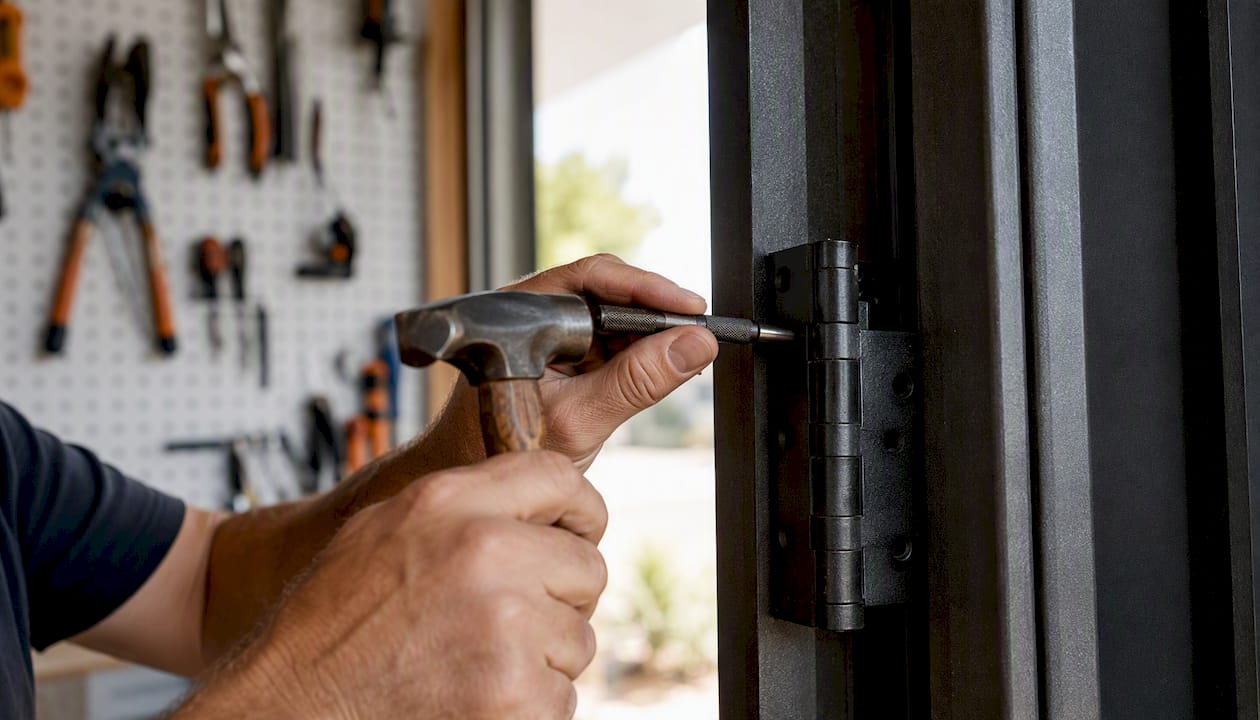
The detail most buyers overlook is the frame. A door that passes AS5041 anti-jemmy testing in a masonry-backed frame will not deliver the same resistance when fitted into a deteriorated timber jamb with undersized fixings. The product and the installation are inseparable, which is why choosing an installer with documented experience and a written workmanship warranty matters as much as choosing the right door.
Easterndoors: custom security doors, measured and installed for your home
Easterndoors custom-manufactures steel security doors, aluminium, and stainless steel security doors for residential properties across Melbourne’s Knox and Scoresby areas. The process runs from a detailed on-site measure and consultation through to manufacture, professional installation, and aftercare, with workmanship warranties and a fast turnaround that avoids the long waits common with larger suppliers.
Every door is built to your opening’s exact dimensions and fitted by experienced installers who understand the frame-backing and fixing requirements that make test performance translate to real-world protection. Whether you need a single front door replacement or screens across multiple entry points, the starting point is a no-obligation measure-and-quote. Browse the full door range or book your measure-and-quote directly through Easterndoors to get an accurate price and lead time for your property.
Useful sources and further reading
The sources below are worth consulting directly for technical detail, standards guidance, and product specifications:
- nssa.org.au
- dulux.com.au
- interpon.com
- lockweb.com.au
- Deltana Security Door Hinge Pin – DEL-44368 – Doorware.com
Recommended
- French door security: the complete Australian guide | Eastern Security Doors
- Front door security: a complete guide for Australian homes | Eastern Security Doors
- Apartment door security: your 2026 Australian guide | Eastern Security Doors
- Double security screen doors: your complete Australian guide | Eastern Security Doors