For most aluminium parts where tight tolerances and wear resistance matter, anodising is the better choice. When you need bold colour options, textured surfaces, or a consistent finish across mixed materials, powder coating usually wins. The right answer depends on what the part actually has to do.
Here is a quick guide by priority:
- Tight tolerances or sliding surfaces: Choose anodising (Type II or Type III). The oxide layer adds only a very thin micron-scale thickness, so fits stay predictable.
- Exact brand colour or textured finish: Powder coat. RAL and Pantone matching is straightforward, and the range of textures is far wider.
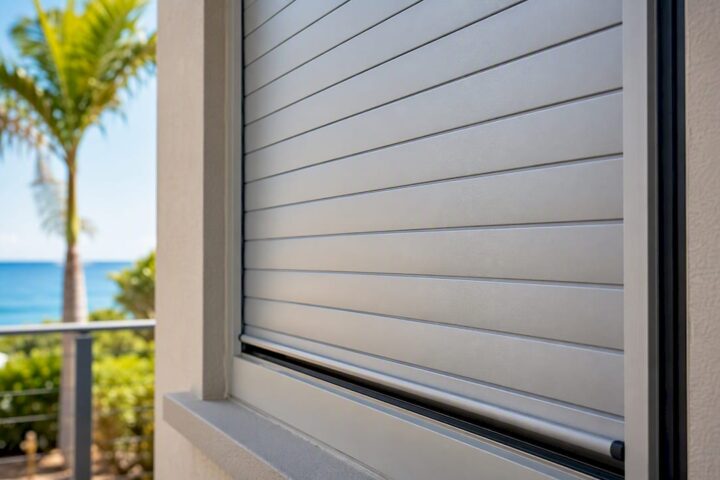
- Coastal or high-UV exposure: Specify PVDF powder coat or Type III hard anodise. Both handle salt air and intense sunlight better than standard options.
- Small batch, fast turnaround: Powder coat typically has lower setup costs and shorter lead times for small runs.
For aluminium security doors, Easterndoors commonly recommends anodised frames for internal components and polyester or PVDF powder coat for external panels, balancing appearance, corrosion resistance, and long-term ease of maintenance.
Table of Contents
- What does anodising actually do to aluminium?
- What does powder coating deliver, and what are your options?
- How do powder coat and anodised finishes compare side by side?
- Which applications suit each finish?
- What do designers and fabricators need to call out on drawings?
- What do powder coating and anodising cost, and how long do they take?
- How do you maintain and repair each finish over time?
- Can you powder coat over anodised aluminium, and what about mixed metals?
- Key takeaways
- The finish choice that actually matters for security doors
- Easterndoors can help you choose and specify the right finish
- Useful sources and further reading
What does anodising actually do to aluminium?
Anodising is an electrochemical process, not a coating applied on top of the metal. The aluminium part is submerged in an acid electrolyte bath and connected to an electrical circuit. The process converts the outer layer of the aluminium itself into aluminium oxide, growing an integrated, porous oxide layer that is then dyed (if colour is required) and sealed. Because the layer grows into and out of the surface rather than sitting on top of it, it cannot peel or flake the way a paint or powder coat film can.
The three main anodising types differ primarily in the electrolyte chemistry and the resulting thickness and hardness:
- Type I (chromic acid anodise): Produces a very thin layer, typically 0.5–2.5 µm. Used mainly in aerospace where minimal dimensional change is critical. Rarely specified for architectural or security door work.
- Type II (sulphuric acid anodise): The most common commercial grade. Typical thickness is a few microns thick. Provides good corrosion resistance, a clean metallic appearance, and accepts dyes well. Standard for window frames, door hardware, and consumer products.
- Type III (hardcoat or hard anodise): Uses a modified sulphuric process at lower temperatures and higher current. Produces a thicker, denser oxide layer, often exceeding 25 µm, with surface hardness that can reach 400–600 HV. Specified for sliding components, wear surfaces, and parts exposed to abrasion.
The finish appearance varies by alloy and dye. Clear anodise on 6063 aluminium gives a bright, silver-grey metallic look. Dyed anodise (black, bronze, champagne) is common for architectural extrusions. Colour consistency across multiple batches can vary slightly because the process depends on alloy composition.
Quick specs at a glance:
- Type I: 0.5–2.5 µm, aerospace and precision parts
- Type II: 5–25 µm, architectural, hardware, consumer goods
- Type III: 25+ µm, wear surfaces, industrial, marine
- Hardness (Type III) is very high, exceeding many common coatings
- Finish: metallic, semi-gloss to matte, depending on alloy and sealing
Pro Tip: On design drawings, call out masking locations explicitly (e.g. “mask threads M6 and bearing seat Ø20h6 before anodise”). For Type II, add a bilateral allowance of +12–25 µm per surface to maintain press fits. For Type III, increase that allowance to +25–50 µm per surface and specify post-anodise reaming for critical bores.
What does powder coating deliver, and what are your options?
Powder coating applies a dry thermoplastic or thermoset polymer powder to the aluminium surface using an electrostatic gun. The charged powder adheres to the grounded part, which is then cured in an oven at roughly 160–200°C. The heat melts and cross-links the powder into a continuous, hard polymer film. Unlike liquid paint, powder coating emits very few volatile organic compounds (VOCs) during application, which is one of its genuine environmental advantages.
Film thickness typically runs 50–150 µm, though architectural specifications often target 60–80 µm for a balance of coverage and dimensional control. The three main chemistries each suit different environments:
- Polyester: The standard outdoor choice. Good UV resistance, colour retention, and flexibility. Suitable for most residential and commercial architectural work.
- Epoxy: Excellent chemical and abrasion resistance, but poor UV stability. Best for internal components or parts that will be topcoated.
- PVDF (polyvinylidene fluoride): Superior UV and chemical resistance. Recommended for long-life architectural exteriors, particularly in high-UV climates like coastal and northern Australia. Higher cost than standard polyester.
The aesthetic range is one of powder coating’s strongest selling points. Gloss, satin, matte, textured (fine and coarse), wrinkle, and metallic finishes are all available. Colour matching to RAL or Pantone standards is reliable and repeatable across large batches, which matters when you are finishing door frames, panels, and trims that all need to match.
Quick specs at a glance:
- Typical film thickness: 50–150 µm
- Chemistries: polyester, epoxy, PVDF
- Colour range: virtually unlimited (RAL, Pantone, custom)
- Textures: gloss, satin, matte, textured, wrinkle, metallic effect
- Cure temperature: approximately 160–200°C
Pro Tip: Mask all threaded holes, bearing seats, and precision bores before powder coating. The 60–150 µm film will fill an M6 thread enough to cause assembly problems. Also note that the cure temperature can affect temper in thin aluminium sections — confirm with your finisher if the part is heat-treated.
How do powder coat and anodised finishes compare side by side?
Anodising leads on wear resistance, dimensional precision, and metallic aesthetics. Powder coating leads on colour range, impact resistance, and cost-effectiveness for large batches. Neither finish is universally superior — the right choice depends on the specific demands of the part and its environment.
| Dimension | Anodising (Type II) | Anodising (Type III) | Powder coat (polyester) | Powder coat (PVDF) |
|---|---|---|---|---|
| Process | Electrochemical oxide growth | Electrochemical (heavy duty) | Electrostatic spray + oven cure | Electrostatic spray + oven cure |
| Typical thickness (µm) | 5–25 µm | 25+ µm | 50–150 µm | 50–100 µm |
| Wear resistance | Moderate | Very high (400–600 HV) | Moderate | Moderate |
| Corrosion resistance | Good (sealed) | Excellent | Good (with pretreatment) | Excellent |
| UV / colour stability | Good (fades slowly) | Good | Good | Excellent |
| Heat tolerance | High (oxide is stable) | High | Moderate (softens ~200°C) | Moderate |
| Aesthetics | Metallic, limited colour | Metallic, limited colour | Unlimited colour and texture | Unlimited colour and texture |
| Dimensional impact | Minimal (microns) | Low–moderate | Significant (50–150 µm) | Significant (50–100 µm) |
| Repairability | Difficult (re-anodise required) | Difficult | Touch-up possible | Touch-up possible |
| Cost / lead time | Moderate; batch-dependent | Higher; specialist required | Lower for large batches | Higher; specialist required |
| Common applications | Frames, hardware, extrusions | Sliding parts, wear surfaces | Panels, facades, doors | Coastal facades, long-life exteriors |
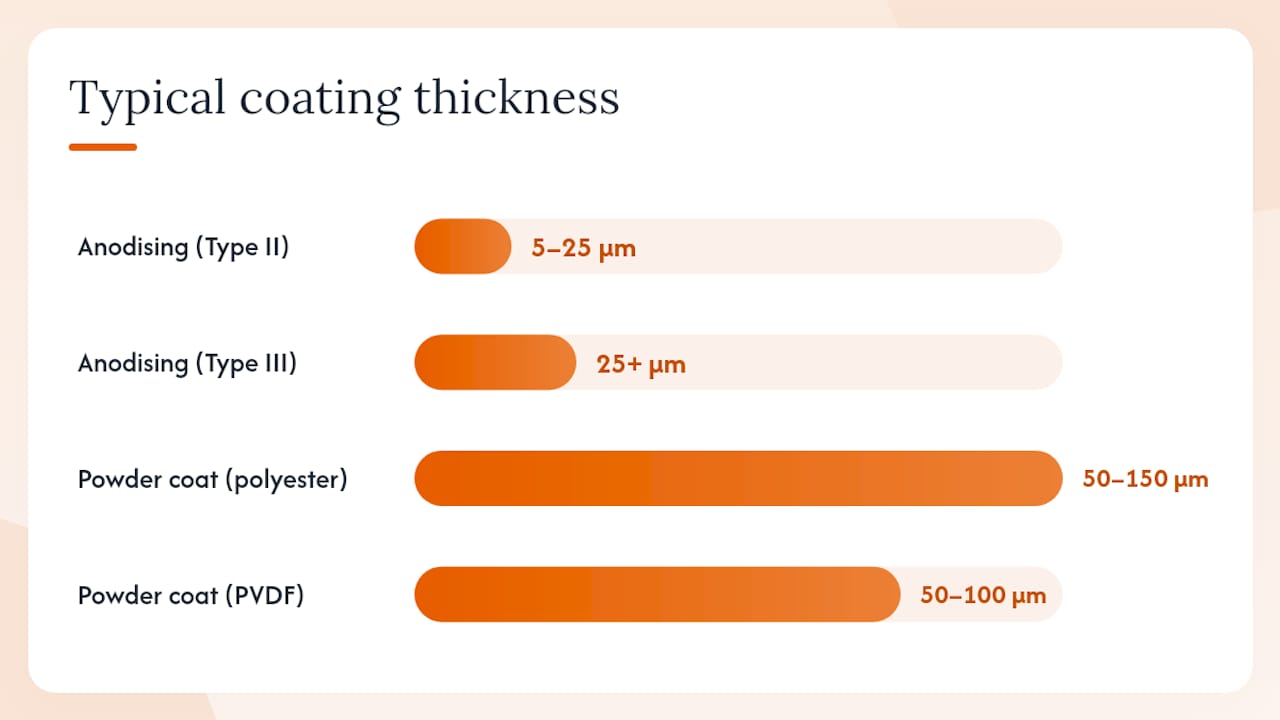
The edge cases are worth calling out. Type III hard anodise is the clear choice for any surface that experiences sliding contact or repeated abrasion — think door track runners, pivot pins, and hinge barrels. The hardness advantage over powder coat is substantial. On the other hand, PVDF powder coat outperforms standard Type II anodise in long-term UV and chemical resistance, particularly in Queensland and Western Australian coastal conditions where UV index regularly exceeds 11.
When parts require tolerances of ±0.01–0.05 mm, anodising is the practical choice because it adds only microns to each surface. Powder coat at 60–150 µm requires deliberate allowances on every precision feature.
Pro Tip: For a security door frame that needs both a metallic look on internal sections and a colour-matched exterior, specify Type II anodise on internal extrusions and polyester powder coat (or PVDF for coastal sites) on external panels. Request sample panels from your finisher before committing to a colour — powder coat batches can vary slightly in sheen.
Which applications suit each finish?
The finish decision usually comes down to the part’s primary job. Anodising suits applications where the metallic appearance, dimensional stability, and integrated oxide layer matter most. Powder coating suits applications where colour consistency, impact resistance, and finish variety are the priority.
- Security doors: Powder coat for external panels and screens; anodise for internal structural extrusions. Easterndoors applies this split-spec approach across its aluminium door range.
Australia coastal note: Along the eastern seaboard from Sydney to Cairns, and across coastal Western Australia, salt-laden air accelerates corrosion on inadequately specified finishes. For any exterior aluminium within roughly 1 km of the ocean, specify either Type III anodise with a quality sealant or PVDF powder coat over a chromate or zirconium pretreatment. Standard polyester powder coat without proper pretreatment will show corrosion at cut edges and fastener holes within a few years in these environments.
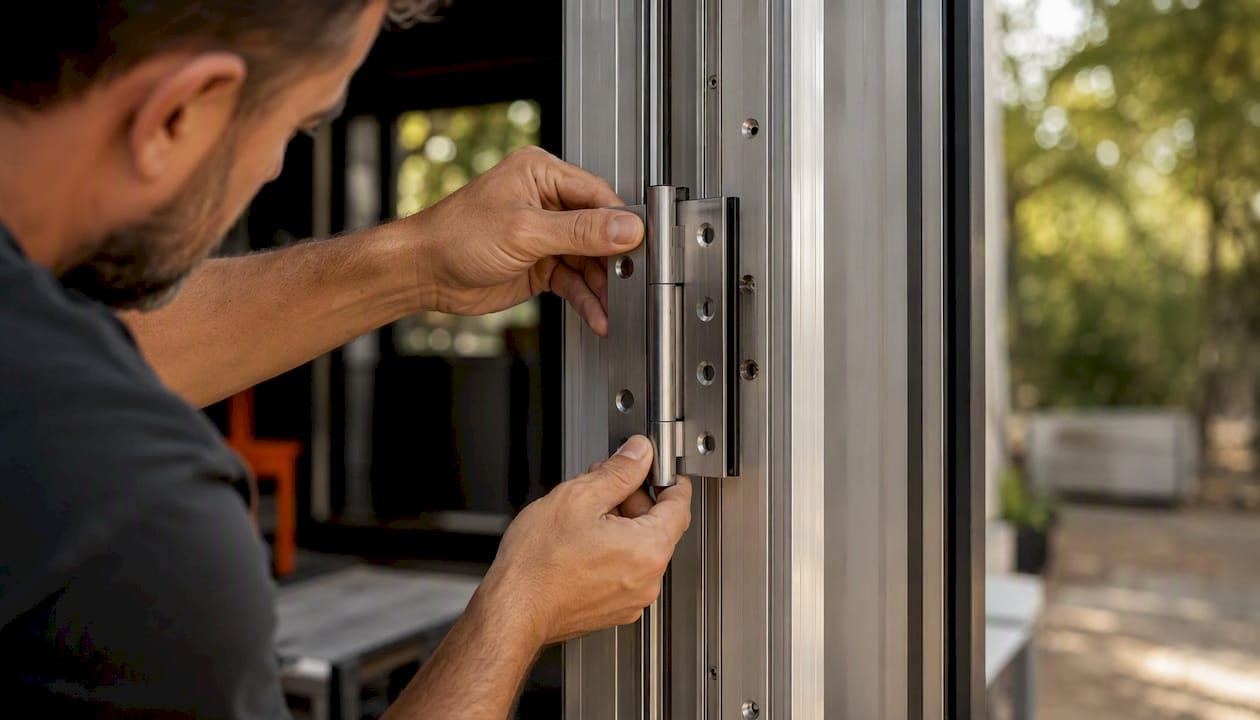
For mixed-material assemblies, powder coat is often simpler. A steel hinge on an aluminium door frame can be powder coated in the same batch and colour. Anodising only works on aluminium, so mixed assemblies require separate finishing operations and careful colour matching between the anodised aluminium and the painted steel.
What do designers and fabricators need to call out on drawings?
Specifying a finish correctly on a drawing or purchase order prevents rework. The most common problems — seized threads, out-of-tolerance bores, and poor adhesion at welds — all stem from missing or vague finish callouts.
Drawing checklist for anodising:
- Specify type (I, II, or III) and minimum/maximum thickness in µm
- Call out all masking locations (threads, bearing seats, electrical contact areas)
- Note post-anodise operations required (reaming, tapping, assembly)
- Specify dye colour and sealing type (hot DI water seal, nickel acetate, or PTFE for dry-lube applications)
- Flag weld zones: weld filler alloys often anodise to a different colour than the parent metal — specify if colour match at welds is required
Drawing checklist for powder coating:
- Specify film chemistry (polyester, epoxy, PVDF) and target thickness range (e.g. 60–80 µm)
- Specify colour by RAL or Pantone number and gloss level (e.g. RAL 9005 Jet Black, 30% gloss)
- Call out masking locations (all threaded holes, precision bores, grounding/earthing points)
- Note cure temperature sensitivity if the part is heat-treated aluminium
- Specify pretreatment (chromate conversion, zirconium, or iron phosphate) for corrosion-critical parts
Typical thickness and tolerance allowances:
| Feature | Anodise (Type II) | Anodise (Type III) | Powder coat |
|---|---|---|---|
| Clearance fit | +12–25 µm per surface | +25–50 µm per surface | +60–150 µm per surface |
| Threaded holes | Mask or re-tap after | Mask or re-tap after | Always mask |
| Press fit / bearing seat | +12 µm per surface | +30 µm per surface | Machine after coating |
| Flat mating surface | No allowance needed | Minor lapping may be needed | Allow for film build |
Pro Tip: When sending a purchase order to a finisher, include a one-page finish specification sheet that lists: alloy, temper, finish type, thickness range, colour reference, masking drawing reference, and any post-finish operations. Ask for a sample panel (minimum 100 mm × 100 mm) before the production run. This single step eliminates most colour and texture disputes.
What do powder coating and anodising cost, and how long do they take?
Powder coating is generally cheaper than anodising for large batches, and it is usually faster to turn around. Anodising, particularly Type III, requires specialist equipment and tighter process control, which pushes both cost and lead time up.
Key cost drivers for powder coating:
- Film chemistry (PVDF costs more than polyester)
- Custom colour matching (standard RAL colours are cheaper than custom mixes)
- Masking complexity (more masked features = more labour)
- Batch volume (per-part cost drops significantly with larger batches)
- Pretreatment specification (chromate or zirconium pretreatment adds cost but is worth it for exterior parts)
Key cost drivers for anodising:
- Type (Type III is more expensive than Type II due to process intensity)
- Sealing specification (nickel acetate or PTFE seals cost more than hot water)
- Alloy (some alloys anodise poorly and require extra process steps)
- Batch size (rack setup costs are spread across the batch — small runs are proportionally expensive)
- Specialist availability (Type III hard anodise is not available at every job shop in Australia)
For typical Australian job shop lead times, standard polyester powder coat on a small batch (under 20 parts) can often be turned around in 3–5 business days. Type II anodise on a similar batch runs 5–10 business days. Type III hard anodise and PVDF powder coat both typically require 10–15 business days, and in some states you may need to freight parts to a specialist finisher, adding transit time.
Type III hard anodise capacity in Australia is concentrated in Melbourne, Sydney, and Brisbane. If you are in a regional area or need a fast turnaround, confirm availability before specifying it on a tight schedule. PVDF powder coat is more widely available but still less common than standard polyester — check with your local finisher early in the design process.
How do you maintain and repair each finish over time?
Powder coat and anodised finishes have different maintenance needs and very different repair options. Knowing which you have on a door or fitting changes how you clean it and what you can do when damage occurs.
Powder coat maintenance:
- Clean with mild detergent and water; avoid abrasive pads or solvents that attack the polymer film
- Inspect annually for chips, cracks, or corrosion at cut edges and fastener holes
- Touch-up small chips with a matching aerosol or brush-applied powder coat touch-up paint (colour match is approximate)
- For significant damage or widespread chalking, full recoating is the practical option — the part is stripped, pretreated, and recoated
- Powder coat has low VOC emissions during application, but stripping old coatings generates waste that requires appropriate disposal
Anodised finish maintenance:
- Clean with pH-neutral detergent and water; avoid alkaline cleaners (bleach, caustic soda) which attack the oxide layer
- Inspect for white powdery deposits (signs of oxide breakdown) or pitting, particularly in coastal environments
- Re-sealing with a proprietary anodise sealant can extend service life if the original seal has degraded
- Re-anodising requires stripping the part back to bare aluminium and running the full electrochemical process again — this is only practical for parts that can be removed and sent to a finisher
- Anodising uses acid baths that require proper waste treatment; both processes have environmental considerations that responsible finishers manage under Australian environmental regulations
For security doors specifically, the practical repair question is usually whether to touch up a powder coat chip or replace a panel. Easterndoors covers this decision in detail, including when powder coating an existing door makes sense versus installing a new one.
Can you powder coat over anodised aluminium, and what about mixed metals?
Yes, you can powder coat over anodised aluminium, but the surface preparation requirements are different from coating bare metal. The anodised layer is chemically inert and non-porous after sealing, so standard pretreatment (iron phosphate wash) may not provide adequate adhesion. The correct approach is to lightly abrade the anodised surface and apply a chromate or zirconium conversion coating before powder coating. Without this step, adhesion failures and delamination are common, particularly at edges and around fasteners.
Common compatibility questions:
- Powder coat over anodise: Possible with correct surface prep (abrasion + conversion coat). Useful when you want to change colour on an existing anodised part without stripping.
- Anodise over powder coat: Not possible. Anodising requires bare aluminium — the electrochemical process cannot work through a polymer film.
- Mixed aluminium alloys in one anodise batch: Possible, but colour consistency varies by alloy. 6061 and 6063 anodise to slightly different shades. Specify this risk on your drawing if colour match across alloys is critical.
- Steel and aluminium in one powder coat batch: Straightforward. Both can be coated in the same oven cycle, which is one reason powder coat is common for security door assemblies that combine aluminium frames with steel hardware.
- Galvanic corrosion in mixed-metal assemblies: Both anodise and powder coat provide electrical insulation that reduces galvanic corrosion risk between dissimilar metals. However, if the finish is damaged at a fastener or contact point, bare aluminium and steel (or stainless) can form a galvanic couple. Design for isolation at contact points, or specify nylon washers and sleeves at fastener locations.
Pro Tip: When specifying a finish for a mixed-metal assembly (aluminium frame with stainless mesh or steel hinges), powder coat is the simpler choice because it covers all metals in one operation. If you need anodise on the aluminium for aesthetic or tolerance reasons, finish the aluminium first, then powder coat or paint the steel components separately and assemble.
Key takeaways
Anodising is the better choice for tight tolerances and wear resistance; powder coating wins on colour range, mixed-material coverage, and cost efficiency for larger batches.
| Point | Details |
|---|---|
| Anodise for precision and wear | Type II adds only 5–25 µm; Type III reaches 400–600 HV hardness for sliding and abrasion surfaces. |
| Powder coat for colour and coverage | Film thickness of 50–150 µm suits colour-critical and mixed-material assemblies; PVDF excels in coastal UV conditions. |
| Tolerances drive the decision | Parts requiring ±0.01–0.05 mm fits need anodise; powder coat requires deliberate allowances on every precision feature. |
| Coastal Australia needs an upgrade | Specify Type III anodise or PVDF powder coat for any exterior aluminium within roughly 1 km of the ocean. |
| Easterndoors split specification | Anodised frames for internal extrusions, polyester or PVDF powder coat for external panels — a practical approach for residential security doors. |
The finish choice that actually matters for security doors
The debate over powder coat versus anodised finishes tends to focus on aesthetics, and that is understandable. Colour and texture are what homeowners see every day. But for a security door, the finish also has to survive decades of UV exposure, salt air, cleaning products, and the mechanical wear of a door that opens and closes thousands of times a year.
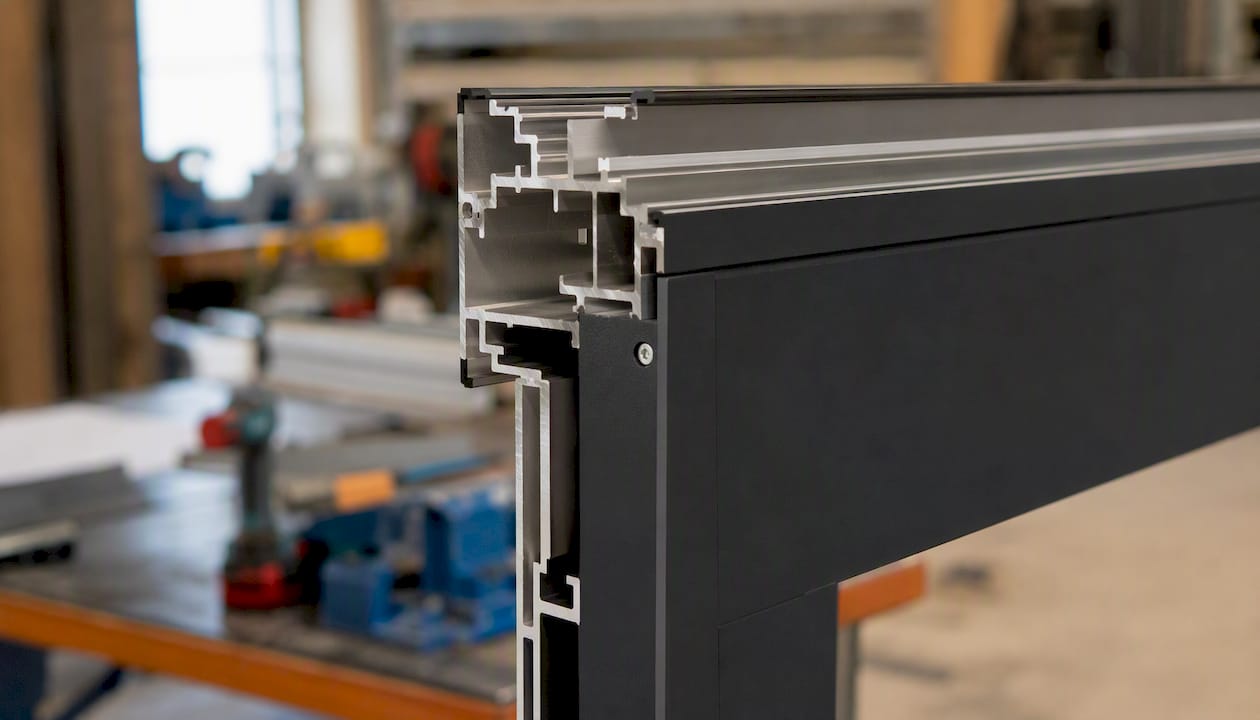
The split-specification approach — anodised aluminium for structural extrusions, powder coat for external panels — is not a compromise. It is the technically correct answer for a product that has to perform on multiple axes simultaneously. Anodise gives you dimensional stability and a hard, integrated surface on the parts that carry load and maintain alignment. Powder coat gives you colour consistency, impact resistance, and the ability to match steel hardware in a single finishing operation.
What gets overlooked in most finish comparisons is the pretreatment step. A PVDF powder coat applied over a poor pretreatment will fail at the edges within a few years in a coastal environment. A Type II anodise on a poorly prepared alloy will show pitting and colour variation across the batch. The finish chemistry matters, but the surface preparation before the finish is applied matters just as much. Specifying the finish type without specifying the pretreatment is a common and costly oversight.
Easterndoors can help you choose and specify the right finish
Choosing between powder coat and anodised aluminium is straightforward once you know what the part needs to do. Getting the specification right before manufacture saves time, money, and the frustration of rework.
Easterndoors handles the full process for residential security doors in Melbourne and surrounding areas: finish consultation, sample panels, custom colour matching, manufacture, and professional installation. Whether you are replacing an existing door or specifying a new installation, the team reviews finish options during the quotation process and provides sample panels so you can confirm colour and texture before a single part is cut.
For homeowners who want to see the full range of aluminium, steel, and stainless options, the complete door range covers available materials, finishes, and configurations. To get a quote or arrange a consultation, contact Easterndoors directly through the website.
Useful sources and further reading
The sources below cover the technical standards, process details, and application guidance referenced throughout this article.
- Anodizing vs Powder Coating: Sheet Metal Finish Guide
- Applications | Powder Coating Institute
- Powder Coating vs. Anodizing for Aluminium | Xometry Pro
- Anodizing vs Powder Coating
- Galvanic corrosion — Wikipedia
- Anodized aluminium applications | Anodizing.org
- Should You Install a New Security Door or Powder Coat an Existing One? | Eastern Security Doors
Recommended
- Should You Install a New Security Door or Powder Coat an Existing One? | Eastern Security Doors
- Powder coated security doors: the Australian buyer’s guide | Eastern Security Doors
- Aluminium Doors Melbourne – Aluminium Doors by ESD
- Amplimesh vs Crimsafe: which security screen suits your home? | Eastern Security Doors