For most Australian homes, Crimsafe delivers superior forced-entry resistance through its screw-clamp fixing and thicker mesh, while Invisi-Gard is the stronger choice for coastal properties where 316-grade stainless steel and corrosion resistance matter most. Both exceed AS5039/5041 by a significant margin, so the decision comes down to your environment, risk profile, and budget rather than one system being outright better.
- Coastal home: Choose Invisi-Gard with 316-grade stainless mesh to resist salt-air corrosion over the long term.
- High-security or ground-floor vulnerability: Choose Crimsafe, particularly Crimsafe Ultimate, for maximum impact resistance and tamper-resistant mechanical fixing.
- Budget-conscious homeowner: Crimsafe Classic or a locally manufactured custom screen from Easterndoors can deliver compliant security at a more accessible price point.
Table of Contents
- Crimsafe vs Invisi-Gard: side-by-side comparison
- What does mesh grade actually mean for your home?
- How does the mesh fixing method affect impact resistance?
- Does frame construction make a real difference to security?
- What hardware and locks should you expect on a premium security screen?
- How do the strength and impact ratings compare in practice?
- How do you protect a coastal installation from corrosion?
- What should your warranty actually cover?
- What should you expect from installation and customisation?
- What drives the price of a security screen?
- How long will a security screen last, and what maintenance does it need?
- How to choose between Crimsafe and Invisi-Gard: a practical checklist
- Final recommendation: which system should you choose?
- Key takeaways
- How Easterndoors advises local homeowners
- Get a site measure and itemised quote from Easterndoors
- Useful sources and further reading
Crimsafe vs Invisi-Gard: side-by-side comparison
| Product | Mesh material & grade | Mesh fixing method | Impact / strength rating | Frame build | Warranty | Coastal suitability | Best for |
|---|---|---|---|---|---|---|---|
| Eastern Security Doors | Aluminium, steel or stainless (custom spec) | Custom to spec | Compliant to AS5039/5041 | Aluminium, steel or stainless; custom profiles | Direct manufacturer warranty; local service | Stainless options available | Local supply, custom sizing, professional install with aftercare |
| Crimsafe Classic | 304 stainless, 0.9 mm | Screw-Clamp™ | ~550 J vendor-reported impact resistance | Aluminium frame, reinforced corners | 10-year (conditions apply) | Moderate; 304 grade | Standard residential security installs |
| Crimsafe Ultimate | 304 stainless, 0.9 mm+ | Screw-Clamp™ | ~550 J vendor-reported impact resistance | Heavy-duty aluminium; premium hardware | 10-year (conditions apply) | Moderate; 304 grade | High-risk residential or commercial sites |
| Crimsafe iQ | 304 stainless | Screw-Clamp™ | Vendor-reported compliant | Aluminium; configurable profiles | 10-year (conditions apply) | Moderate; 304 grade | Aesthetic integration with mechanical fixing |
| Invisi-Gard | 316 stainless | EGP pressure-fit wedge | ~450 J vendor-reported impact resistance | Aluminium frame | 10-year (conditions apply) | High; 316 grade preferred near coast | Coastal homes; minimal screw-free finish |
Note: Impact figures above are vendor-reported. Request accredited lab test certificates and AS5039/5041 compliance documentation from your installer before signing off on any product.
Both Crimsafe and Invisi-Gard report impact resistance well above the AS5039/5041 threshold, with Crimsafe citing approximately 550 joules and Invisi-Gard approximately 450 joules in vendor testing.
What does mesh grade actually mean for your home?
The two grades you will encounter are 304 and 316 stainless steel. Both are high-tensile alloys, but 316 contains molybdenum, an element that significantly improves resistance to pitting and crevice corrosion in chloride-rich atmospheres — the kind found within a few kilometres of the Australian coastline.
Crimsafe products typically use 304-grade mesh, compensating with greater wire diameter (0.9 mm) and the mechanical advantage of the screw-clamp fixing to achieve high impact resistance. Invisi-Gard’s 316-grade stainless mesh is thinner in some configurations, trading a degree of raw tensile strength for superior corrosion performance. Neither trade-off is wrong; they suit different environments.
Choosing by location:
- Within 1 km of the coast or tidal waterways: 316-grade mesh is worth the premium. Salt deposits accelerate pitting on 304 mesh, and the long-term cost of early replacement outweighs the upfront saving.
- Inland or suburban locations: 304-grade mesh with a quality protective coating performs well and is widely available.
- High-bushfire or industrial zones: Confirm mesh and frame coatings are rated for your specific exposure with your installer.
Pro Tip: For coastal installations, ask your installer about a powder-coated or anodised aluminium frame in addition to 316 mesh. The frame corrodes before the mesh in many cases, and a quality frame finish extends the whole screen’s service life.
How does the mesh fixing method affect impact resistance?
The fixing method is where Crimsafe and Invisi-Gard diverge most clearly in engineering terms, and it directly affects how the screen performs under repeated attack.
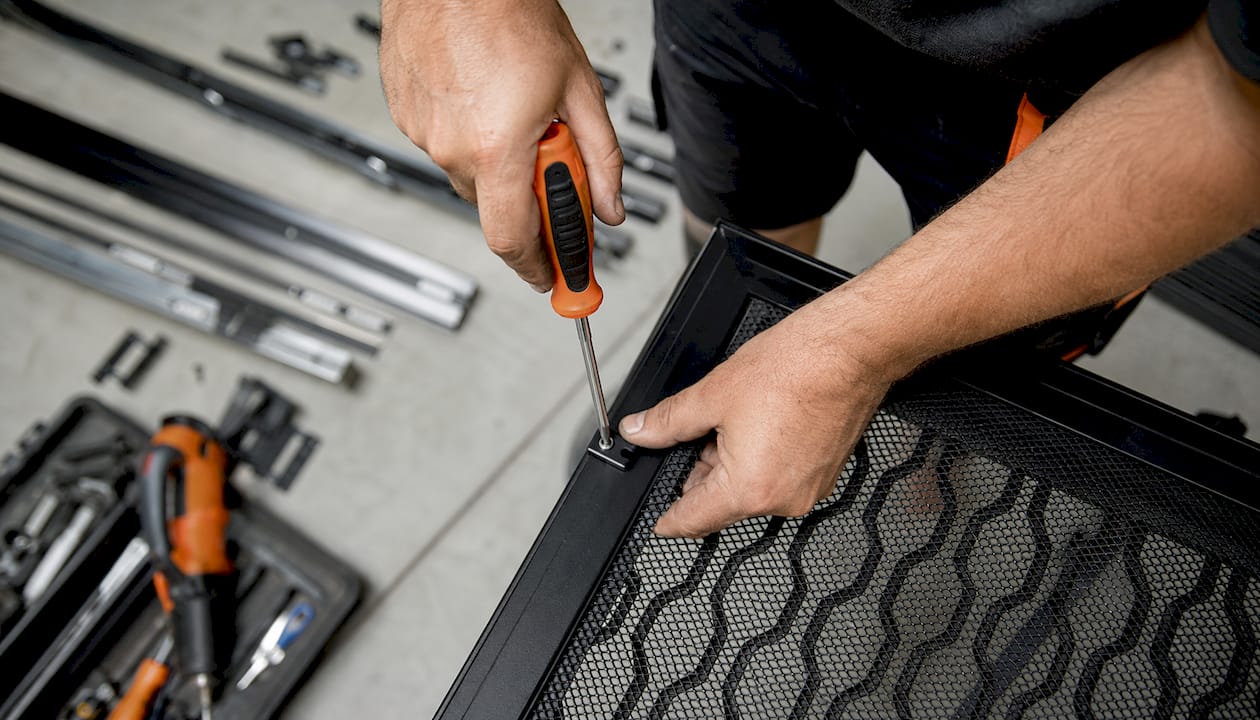
Crimsafe’s Screw-Clamp™ system uses tamper-resistant screws to clamp the mesh continuously around the perimeter of the frame. When force is applied, the load distributes across the entire clamped edge rather than concentrating at a single point. Under repeated strikes, that distributed bond holds up better because no single fixing point bears the full stress.
Invisi-Gard’s Extreme Grip Protection (EGP) system uses a pressure-fit PVC wedge to lock the mesh into the frame channel without visible screws. The result is a clean, minimal finish that many homeowners prefer aesthetically. The trade-off is that grip relies on localised pressure rather than a continuous mechanical bond, which can mean slightly different performance characteristics under sustained or repeated impact.
Key differences at a glance:
- Screw-Clamp (Crimsafe): Continuous perimeter bond; tamper-resistant screws; distributed load transfer; visible fixing points on close inspection.
- EGP wedge (Invisi-Gard): Pressure-fit; no visible screws; clean finish; localised grip at wedge contact points.
- Practical implication: For ground-floor entry points in higher-risk areas, the continuous mechanical bond of the screw-clamp system provides greater confidence under repeat-strike scenarios.
Does frame construction make a real difference to security?
Yes, and it is one of the most overlooked factors when homeowners compare security screens. A high-grade mesh fixed into a poorly constructed frame is only as strong as its weakest point, which is usually a corner joint or a shallow frame section that flexes under load.
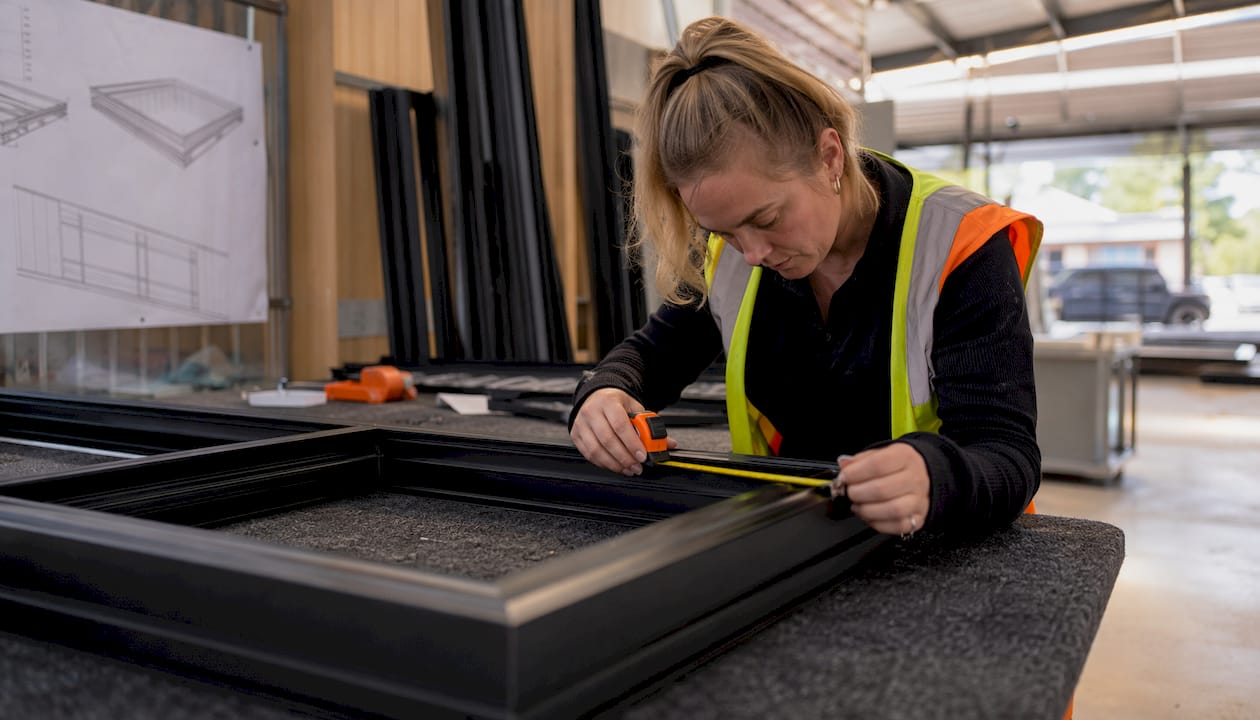
Quality security screen frames use extruded aluminium profiles with sufficient section depth to resist bending. Corner joints should be welded or mechanically reinforced rather than simply mitred and screwed. Crimsafe and Invisi-Gard both specify frame profiles engineered to work with their mesh systems, and certified installers are trained to fit them correctly.
Frame considerations by door type:
- Hinged security doors: Frame depth and hinge reinforcement are critical; look for a minimum of three hinges on full-height doors.
- Sliding security doors: The track system and interlock must be rated to the same standard as the screen itself; a weak track undermines the mesh.
- French doors and larger openings: Wider panels require heavier frame profiles and may need a centre post or astragal bar to maintain rigidity.
- Custom openings: A local manufacturer like Easterndoors can fabricate frames to non-standard dimensions without compromising the structural profile.
What hardware and locks should you expect on a premium security screen?
Hardware is the component most commonly downgraded to reduce cost, and it is the first thing a determined intruder will target. A quality security screen should include locks and hinges that match the strength of the mesh and frame.
Lock types to look for:
- Multi-point locking systems: Engage the frame at three or more points simultaneously, distributing load and making lever attacks far less effective.
- Deadbolts: Single-point but robust; suitable for secondary screens where a multi-point system is already on the primary door.
- Sashlocks: Combine a latch and a deadbolt; common on hinged security doors and adequate for most residential applications when the bolt throw is at least 20 mm.
Hinge considerations:
- Fixed-pin hinges prevent hinge removal from the outside.
- Security hinges with anti-lift tabs stop the door being lifted off the frame even if the pin is accessible.
- Three-hinge configurations on full-height doors spread load and reduce frame stress at the top and bottom corners.
Pro Tip: At the quote stage, ask the installer to name the lock brand and model, confirm it carries an independent test rating, and clarify whether the key can be keyed-alike with your existing door locks. Keying-alike is a small convenience that many homeowners overlook until after installation.
How do the strength and impact ratings compare in practice?
Vendor-reported figures place Crimsafe at approximately 550 joules and Invisi-Gard at approximately 450 joules in impact testing. Both figures sit well above the AS5039/5041 minimum, which means both systems provide genuine forced-entry resistance for residential applications.
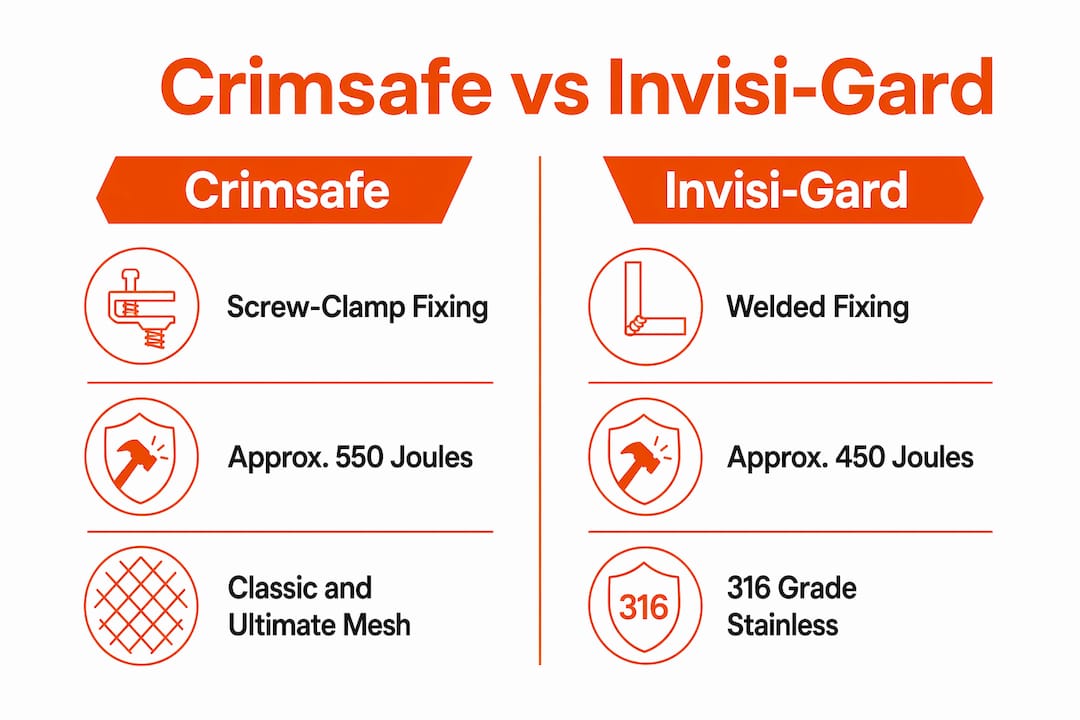
| System | Reported impact resistance | Test standard | Fixing method |
|---|---|---|---|
| Crimsafe (Classic/Ultimate) | ~550 J (vendor-reported) | AS5039/5041 | Screw-Clamp™ |
| Invisi-Gard | ~450 J (vendor-reported) | AS5039/5041 | EGP pressure-fit |
The 100-joule gap is meaningful under repeat-strike conditions. A single strike rarely defeats a quality security screen; it is the second and third strike that test the fixing method. The continuous mechanical bond of the screw-clamp system distributes each successive impact across the full perimeter, which is why Crimsafe’s figures hold up under sustained testing.
Trust signals to request from any installer:
- Accredited independent lab test reports (not just vendor marketing material).
- AS5039/5041 compliance certificate for the specific product being installed.
- Installer accreditation from the manufacturer (both Crimsafe and Invisi-Gard operate certified installer networks).
How do you protect a coastal installation from corrosion?
Salt air is the single biggest threat to security screen longevity in Australian coastal zones, and it affects frames and fixings as much as the mesh itself. The 316-grade stainless in Invisi-Gard products resists chloride-induced pitting far better than 304 in these environments, which is why it is the preferred specification within a few kilometres of the ocean.
Recommended maintenance for coastal installations:
- Rinse mesh and frames with fresh water every two to four weeks to remove salt deposits.
- Use a mild, pH-neutral detergent and a soft brush; avoid abrasive pads that damage protective coatings.
- Inspect fixings, hinges, and lock mechanisms every six months for early signs of surface rust or white deposits.
- Apply a manufacturer-approved protective spray to frames annually.
Warranty coverage for coastal corrosion varies between brands and is almost always conditional on documented maintenance. Failing to follow the brand-approved care schedule is the most common reason warranty claims are rejected.
Pro Tip: At the site visit, run your finger along the bottom frame rail and check the underside of the sill. These are the first areas to show salt accumulation and early corrosion. If a screen already installed nearby shows white deposits or rust streaks at the sill, ask the installer specifically how their product handles that exposure.
What should your warranty actually cover?
Warranty length is one thing; warranty scope is another. A 10-year warranty that excludes coastal environments, requires annual professional servicing, or limits coverage to mesh only is materially different from one that covers the full installation.
Common warranty terms to confirm in writing:
- Frame warranty: Does it cover powder-coat failure, corrosion, and weld cracking, or only structural defects?
- Mesh warranty: Is it voided by impact damage, or does it cover manufacturing defects in the weave?
- Hardware warranty: Locks and hinges are often on a shorter term than the frame; confirm the period.
- Coastal exclusions: Many warranties reduce coverage or require additional maintenance documentation within a specified distance from the coast.
- Maintenance requirements: Confirm exactly what cleaning schedule and products the warranty requires, and get it in writing.
What to request at quote time: Ask for the full warranty document, not just a summary. Confirm the maintenance schedule in writing, the process for lodging a claim, and the expected service turnaround. A reputable installer will provide this without hesitation.
Neglected maintenance near the coast is the most common source of warranty disputes, with salt residue and white deposits on frames and mesh cited repeatedly where brand-approved care was not followed.
What should you expect from installation and customisation?
Professional installation of a security screen involves a site measure, custom fabrication to your opening dimensions, and a return visit for fitting. Lead times vary by manufacturer and region, but a local supplier typically turns around a custom door faster than a national brand’s distribution chain.
Typical installation process:
- Site measure and opening assessment (check for out-of-square frames, existing hardware conflicts, and egress requirements).
- Custom fabrication to measured dimensions.
- Installation, including frame fixing, hinge alignment, lock adjustment, and hardware testing.
- Final inspection and handover, including a demonstration of lock operation and maintenance instructions.
Custom options to discuss at the quote:
- Large panel configurations for wide sliding or stacking doors.
- Integrated pet doors with their own security rating.
- Colour finishes to match existing door and window frames.
- Glazing interfaces where the screen sits adjacent to glass panels.
For upper-floor doors and windows, confirm with your installer whether egress or fall-prevention requirements apply under the National Construction Code. Some configurations require quick-release mechanisms to allow emergency exit, and this must be factored into the hardware and fixing method chosen.
What drives the price of a security screen?
Security screens are a premium product, commonly three to five times the cost of a standard aluminium flyscreen, and the price difference is justified by the engineering required to meet AS5039/5041. Understanding what drives the cost helps you compare quotes on a like-for-like basis.
Main cost drivers:
- Mesh alloy and wire diameter: 316-grade mesh costs more than 304; thicker wire adds further cost.
- Frame profile: Heavier-duty profiles for large openings or high-security applications cost more than standard residential sections.
- Lock and hinge grade: Multi-point locking systems carry a significant premium over basic sashlocks.
- Custom sizing: Non-standard openings require bespoke fabrication and add to labour and material costs.
- Site complexity: Difficult access, out-of-square frames, or multiple simultaneous installations affect installation time.
If your primary need is airflow and insect control rather than forced-entry resistance, security experts advise that a premium security screen may be over-specified for your situation. A quality non-security screen at a fraction of the cost may be the right answer.
Pro Tip: Ask every installer for an itemised quote that separates mesh specification, frame and hardware costs, and labour. A quote that bundles everything into a single line makes it impossible to compare products and identify where you can adjust the specification to suit your budget.
How long will a security screen last, and what maintenance does it need?
With correct care, a quality security screen installed to AS5039/5041 should last 15 years or more in a typical suburban environment. Coastal installations with 316-grade mesh and powder-coated frames can achieve similar longevity, but only with a consistent maintenance routine.
Routine care by environment:
- Inland/suburban: Wash mesh and frames every three to six months with mild detergent and fresh water; inspect hinges and locks annually.
- Coastal: Rinse with fresh water every two to four weeks; inspect fixings and frame surfaces every six months; apply protective coating annually.
Signs a screen needs attention:
- Visible rust streaks or white deposits on the frame or mesh.
- Mesh that has loosened from the fixing channel or shows visible deformation.
- Locks or hinges that bind, stick, or show surface corrosion.
- Frame corners that have separated or show cracking at welds.
Minor issues such as loose hinges or a stiff lock mechanism are straightforward repairs. Mesh that has pulled from the fixing channel, or a frame with structural corrosion, typically warrants replacement rather than repair.
How to choose between Crimsafe and Invisi-Gard: a practical checklist
Working through these steps before you request quotes will sharpen your brief and make it easier to compare what installers actually propose.
- Assess your property’s risk profile. Is the property in a high-burglary area? Are there ground-floor access points that are concealed from the street? Higher risk justifies the maximum impact resistance of Crimsafe Ultimate or a comparable heavy-duty specification.
- Identify your site environment. Within a few kilometres of the coast or tidal waterways? Prioritise 316-grade stainless mesh. Inland suburban? 304-grade with a quality frame finish is adequate.
- Set a realistic budget. Security screens are a security-first investment; if your primary concern is insects or airflow, a non-security screen may be more appropriate. If forced-entry resistance is the goal, budget for the full specification including hardware.
- Consider aesthetics. Invisi-Gard’s EGP system produces a cleaner, screw-free finish. Crimsafe’s fixing points are visible on close inspection. Both are available in a range of powder-coat colours.
- Confirm warranty terms before signing. Read the full warranty document, not a summary. Confirm coastal exclusions, maintenance requirements, and the claims process.
Questions to ask at the onsite quote:
- What mesh grade and wire diameter are you specifying, and why?
- What fixing method does this product use, and can you show me the test certificate?
- What lock brand and model are you supplying, and what is its independent test rating?
- What is the warranty scope, and what maintenance does it require to remain valid?
- What is the lead time from measure to installation?
Red flags that should prompt a second opinion:
- Vague warranty language with no written scope document.
- No independent test evidence or accredited lab report available.
- Hardware with no brand name or test rating.
- A quote that cannot be itemised by mesh, frame, hardware, and labour.
Final recommendation: which system should you choose?
The right choice depends on your specific circumstances, but the pattern is consistent across most Australian homes.
- Coastal properties: Invisi-Gard with 316-grade stainless mesh. The corrosion resistance advantage over 304 is material in salt-air environments, and the EGP system still exceeds AS5039/5041 by a wide margin.
- High-security or ground-floor vulnerability: Crimsafe Ultimate or Crimsafe Classic with the Screw-Clamp™ fixing. The continuous mechanical bond and thicker mesh deliver the highest vendor-reported impact resistance available in a residential screen.
- Standard suburban home, balanced budget: Crimsafe Classic or a locally manufactured custom screen from Easterndoors, specified to AS5039/5041 with quality hardware and a documented warranty.
Your immediate next step: Request an itemised site quote from a certified installer. Ask for the mesh grade, fixing method, lock brand, and warranty document in writing before you commit. For local supply and professional installation in Melbourne and surrounding areas, Easterndoors’ full range covers aluminium, steel, and stainless options with custom sizing and direct aftercare.
Key takeaways
Crimsafe delivers higher vendor-reported impact resistance through its screw-clamp fixing, while Invisi-Gard’s 316-grade stainless mesh makes it the stronger choice for Australian coastal properties.
| Point | Details |
|---|---|
| Coastal vs inland mesh | Choose 316-grade stainless (Invisi-Gard) within a few kilometres of the coast; 304-grade suits inland suburban homes. |
| Fixing method matters | Crimsafe’s Screw-Clamp™ distributes impact across the full frame perimeter; Invisi-Gard’s EGP wedge provides a cleaner finish with localised grip. |
| Impact figures | Vendor-reported figures: Crimsafe ~550 J, Invisi-Gard ~450 J; both exceed AS5039/5041 requirements. |
| Warranty and maintenance | Always obtain the full warranty document; coastal exclusions and maintenance requirements are the most common grounds for rejected claims. |
| Easterndoors | Local manufacturer and installer offering custom aluminium, steel, and stainless security doors with direct warranty support across Melbourne. |
How Easterndoors advises local homeowners
At Easterndoors, the starting point for every consultation is the property itself, not the product catalogue. The mesh grade, fixing method, frame profile, and hardware are matched to the specific opening, the site environment, and the homeowner’s security priorities. A coastal property in Melbourne’s bayside suburbs gets a different specification to a suburban home in the eastern foothills, and that distinction matters for both performance and long-term value.
Clients consistently report that the combination of a thorough site measure, clear explanation of the options, and fast turnaround from manufacture to installation removes the uncertainty that makes security screen decisions feel harder than they need to be. The result is a screen that fits correctly, operates smoothly, and comes with a direct line back to the people who made and installed it if anything ever needs attention.
Easterndoors works with homeowners who want professional advice, custom fabrication, and installation they do not have to second-guess. That is the model, and it is why the aftercare relationship matters as much as the initial install.
Get a site measure and itemised quote from Easterndoors
Choosing between Crimsafe and Invisi-Gard is straightforward once you know your site environment, risk profile, and budget. What takes more time is finding an installer who will put the right specification in writing and back it with genuine aftercare.
Easterndoors provides custom-made security doors and screens across Melbourne, with a site measure, itemised quote showing mesh spec, fixing method, hardware line items, and lead time, all before you commit to anything. If you want stainless steel options for a coastal or high-security application, or a custom aluminium or steel door for a standard residential opening, the full range is available at easterndoors.com.au/range. Book a site measure today and get a written quote you can actually compare.
Useful sources and further reading
- Crimsafe vs. Invisigard: Which Security Screen Is Better? (ClimatePro) — includes vendor impact figures and a comparison of fixing methods; useful for verifying the joule ratings cited in this article.
- Are Crimsafe fly screens worth it? (EZ Windows) — honest cost-benefit analysis; recommended reading before committing to a premium security specification.
- Crimsafe reviews (ProductReview.com.au) — real user feedback on maintenance, coastal performance, and warranty experience.
- InvisiGard vs Crimsafe Security Doors (KNA Security) — installer-perspective comparison with notes on product availability.
- Invisi-Gard VS Crimsafe (Custom Screens) — additional installer commentary on mesh grade trade-offs.
- Easterndoors product range — local aluminium, steel, and stainless security door options with custom sizing and professional installation across Melbourne.
- Choosing the right security door for your home (Easterndoors) — decision framework covering impact strength, environment, and risk profile.