For most Australian homeowners, the single best approach to securing French doors is a professionally measured, custom security screen or door combined with a multipoint locking system and a glazing upgrade. That combination delivers genuine forced-entry resistance while keeping your sight lines clear and your home ventilated — something piecemeal DIY fixes rarely achieve.
Here is what a properly specified solution looks like in practice:
- Custom security screen or door fitted with high-tensile stainless-steel mesh, professionally measured and anchored to a reinforced frame
- Multipoint locking system that engages at the top, centre, and bottom of the active leaf
- Reinforced flush bolts with extended throw and hardened strikes on the passive (inactive) leaf
- Fixed-pin or non-removable hinges to prevent the door being lifted off its frame
- Laminated or impact-resistant glazing, or a quality security film applied to existing glass
Easterndoors offers a free measure and quote for custom security doors and screens across Melbourne and surrounding areas. Getting a site measure is the fastest way to understand exactly which combination suits your doors, your frame condition, and your budget.
Table of Contents
- Why are French doors a security risk?
- What hardware upgrades actually work?
- Why a custom security screen is the right long-term solution
- What does installation involve, and what does it cost?
- How do you choose the right installer?
- Key takeaways
- Why custom security doors are the right call
- Easterndoors: free measure and quote for custom security doors
- Useful sources and further reading
Why are French doors a security risk?
The meeting stile and the large glazed area are the two main vulnerabilities — and most successful forced entries exploit one or both.
French doors lock to each other rather than to a fixed structural point. That central seam, where the two leaves meet, is where leverage does the most damage. A sharp kick or a pry bar applied to the meeting stile can separate the doors even when the lock itself holds, because the surrounding frame and passive leaf bolts often give way first. Weak or worn flush bolts on the passive leaf are a frequent cause of successful forced entries — the bolt throw is too short, the strike plate is undersized, or years of use have left the mechanism loose.
Glass is the second problem. A large, uninterrupted glazed panel lets an intruder survey the interior, and laminated or impact-resistant glass is the only reliable defence against a quiet smash-and-reach attack, where a pane is broken just enough to reach inside and turn a thumbturn. Standard float glass offers almost no resistance to this.
Exposed hinge pins are a third weak point, particularly on outward-opening French doors. If the hinge barrel is accessible from outside and the pins are not fixed, the door can be lifted clear of the frame without touching the lock at all.
Pro Tip: Walk outside and check three things: push each flush bolt home and test whether it holds firm under hand pressure; look at your hinge barrels and confirm the pins cannot be tapped upward; then stand back and note how much of your interior is visible through the glass. Those three checks tell you where to spend your money first.
AS 5039 context: Australian Standard AS 5039 (now updated as AS 5039.1:2023 and AS 5039.2:2024) sets performance requirements for security screen doors and window screens in residential buildings, covering forced-entry resistance, lock specifications, and installation quality. A product that meets this standard has been tested against the specific attack methods described above.
What hardware upgrades actually work?
The most effective approach layers several upgrades rather than relying on any single fix. Multipoint locking, reinforced passive-leaf bolts, hinge reinforcement, laminated glazing, and a fitted security screen together form a defence that is genuinely difficult to defeat quickly.
Multipoint locking systems
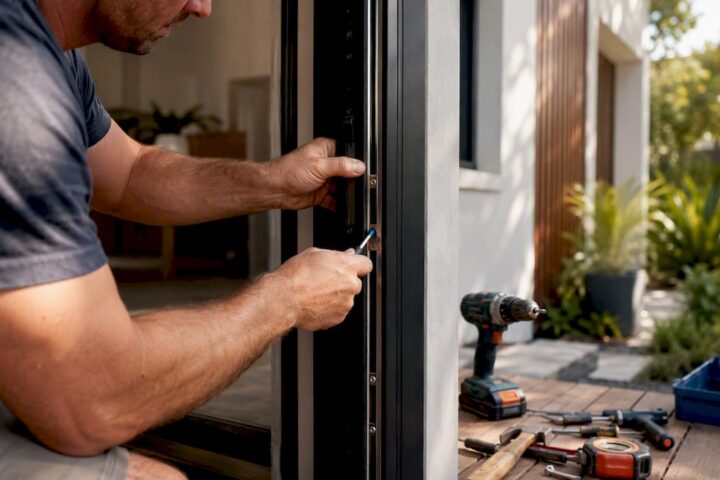
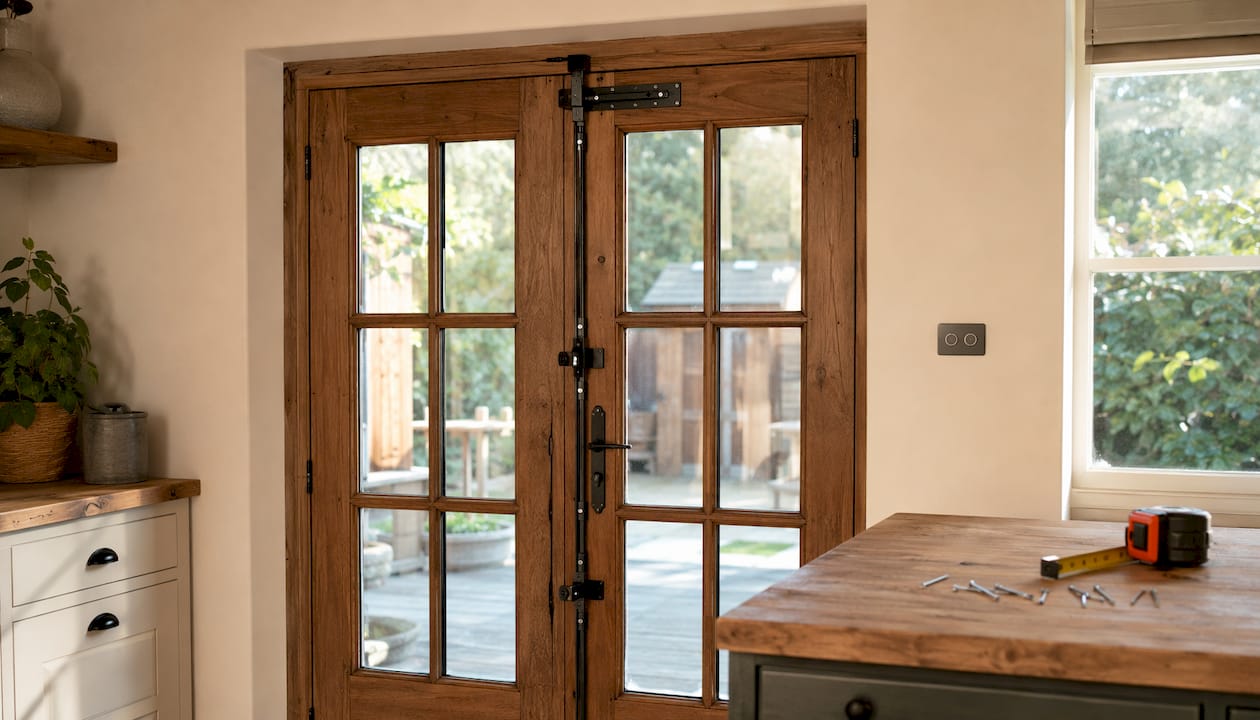
A multipoint lock engages simultaneously at the top, centre, and bottom of the door, distributing the load across the full height of the frame rather than concentrating it at a single latch point. This directly counters levering at the meeting stile. Retrofit multipoint lock kits are available for many existing French door profiles, though a site measure is needed to confirm compatibility. A two-point or multipoint mechanism is a meaningful step up from a single-point deadbolt for any double-door configuration.
Passive leaf reinforcement
The passive (stationary) leaf needs heavy-duty flush bolts at both the top and bottom, with a bolt throw of at least 20 mm and a reinforced strike plate recessed into the frame. For households where the passive leaf is rarely opened, fixing it permanently with a security bolt kit removes the weak point entirely without affecting day-to-day use of the active leaf.
Hinge security
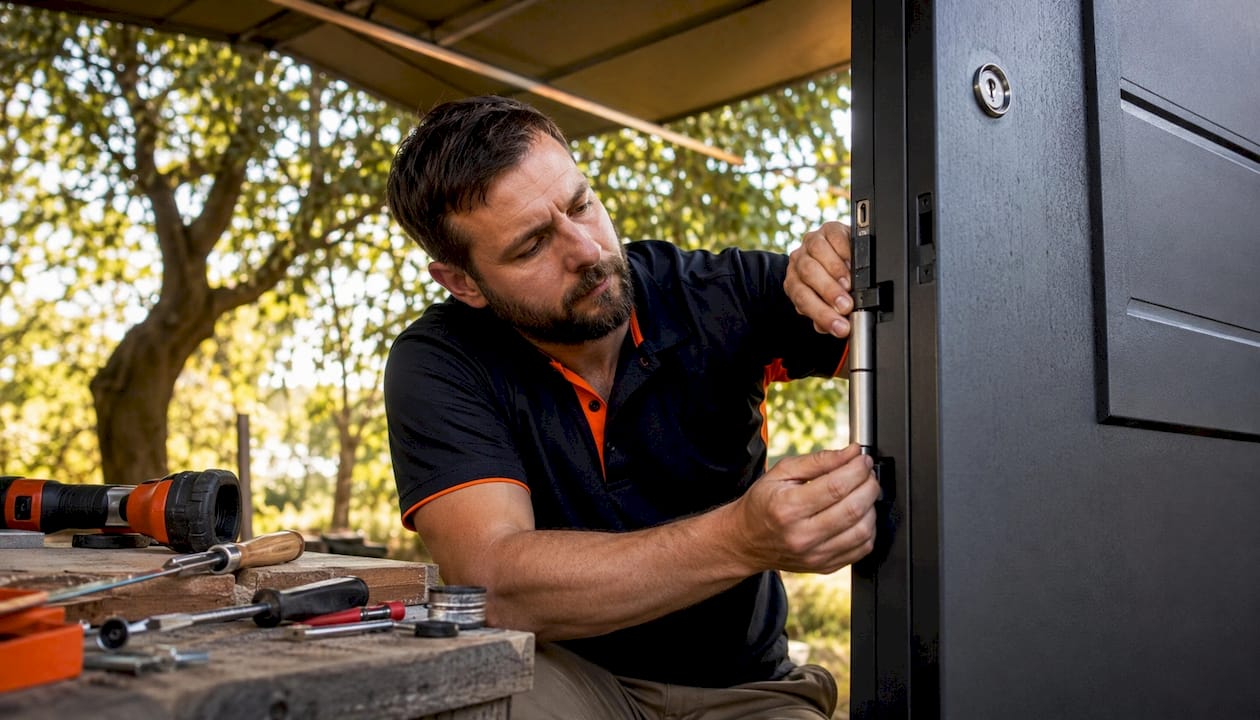
Fixed-pin hinges, or the addition of hinge bolts (sometimes called dog bolts) to existing hinges, prevent the door being lifted off its frame from outside. On outward-opening French doors, this is non-negotiable.
Glazing options
| Upgrade | Security effectiveness | Impact on airflow/appearance | Typical cost band |
|---|---|---|---|
| Security window film | Moderate — holds glass together on impact | None — fully clear options available | Low |
| Toughened (tempered) glass | Moderate — shatters into small pieces, not a sheet | None | Mid |
| Laminated glass | High — broken pane stays bonded, hard to penetrate | None | Mid–high |
| Security screen/door (stainless mesh) | High — prevents access to glass entirely | Minimal — mesh preserves airflow and view | Mid–high |
Security screens and doors
High-tensile stainless-steel mesh fitted in a properly anchored frame is the most complete solution because it protects the glass, maintains ventilation, and adds a visible deterrent. Marine-grade stainless is worth specifying in coastal or high-humidity environments. Aluminium frames suit most residential applications and accept powder-coat finishes that match existing door colours.
Secondary devices
Internal handle clamps, security bars, and audible glass-vibration sensors are useful additions rather than primary defences. They work best when the core hardware (multipoint lock, reinforced passive leaf, hinge bolts) is already in place.
Pro Tip: For older French doors on a tight budget, the two upgrades that deliver the most risk reduction per dollar are heavy-duty passive-leaf flush bolts with reinforced strikes and a quality security film on the glass. Both can be completed quickly and make the door significantly harder to breach while you plan a full security screen installation.
Why a custom security screen is the right long-term solution
A custom security screen or door gives the best balance of genuine resistance, uninterrupted sight lines, and continuous ventilation — and that balance is exactly what piecemeal hardware fixes struggle to deliver on their own.
The key word is custom. An off-the-shelf screen that does not fit the frame precisely leaves gaps that undermine the mesh’s strength. AS 5039.2:2024 makes clear that the resistance of a security screen depends not just on the mesh material but on the fixings, the adaptor frame, and the structural integrity of the surrounding doorframe. A professional installer assesses and, where needed, reinforces the frame before fitting — that step is what separates a compliant installation from one that looks secure but fails under pressure.
High-tensile stainless mesh lets air move freely through the door while blocking physical access to the glass and the lock behind it. For Australian homes that rely on cross-ventilation through summer, that matters. Bars and grilles achieve similar security but block the view and restrict airflow; a well-specified mesh screen does neither.
Homeowner benefits at a glance:
- Preserves natural light and the view through the door
- Allows continuous ventilation without compromising security
- Adds a visible deterrent that makes the entry a lower-priority target for opportunistic intruders
- Reduces insurance risk — insurers commonly expect multipoint locking or rated deadlocks on external doors, and inadequate hardware can affect a claim
- Easy day-to-day use with no additional steps for occupants
Easterndoors manufactures custom security doors and screens in aluminium, steel, and stainless steel, with matched powder-coat finishes and a product warranty. Every installation begins with a professional site measure to confirm frame condition, door dimensions, and the right specification for the opening. Learn more about choosing the right security door for your home’s specific needs.
What does installation involve, and what does it cost?
The process follows four stages: measure, manufacture, install, and service. Understanding each stage helps you plan realistically and compare quotes on equal terms.
Typical process and timeline:
- Measure: A professional visits the site, assesses the frame, takes precise templates, and confirms the specification. Allow 30–60 minutes.
- Manufacture: Custom doors and screens are made to the measured dimensions. Lead times vary by material and complexity.
- Installation: The installer removes any existing screen or fly door, prepares the frame, fits the new door or screen, and checks lock alignment and sealing. A standard installation takes 1–3 hours per opening.
- Service: Post-install adjustments and warranty support as needed.
| Project scope | Typical lead time | Approximate cost band |
|---|---|---|
| Multipoint lock retrofit only | 1–2 weeks (parts) | Low |
| Glazing upgrade (laminated unit replacement) | 2–4 weeks | Mid |
| Full custom security screen with multipoint lock | 3 weeks | Mid–high |
| Full custom steel or stainless security door | 4 weeks | High |
Cost varies with frame material, door size, glazing choice, site access, and whether frame reinforcement is needed. Getting a written, itemised quote is the only reliable way to compare options.
For apartments and units, confirm whether your front door is a fire-rated door before adding any security screen. NSW Fire Brigade guidance advises that heavy security doors fitted in front of fire-rated apartment doors can impede emergency access and egress unless the installation preserves the main door’s self-closing function. This applies across most Australian states, not just New South Wales.
Spring and autumn are generally the most practical seasons for installation — frames are stable, and lead times from manufacturers tend to be shorter outside the summer peak. Booking a measure early in the season reduces the chance of delays. For a detailed walkthrough of what happens on installation day, the security door installation guide from Easterndoors covers each step.
How do you choose the right installer?
Ask for a site measure, written scope of works, explicit hardware specifications, and a clear warranty before signing anything. Those four items separate professional installers from those cutting corners.
Minimum credentials to confirm:
- Local Australian installation experience with verifiable references
- Written warranty covering both the product and the installation workmanship
- Public liability insurance (ask for the certificate)
- Compliance with AS 5039.1:2023 and AS 5039.2:2024 where the product is rated to that standard
- Ability to supply before-and-after photos of comparable past installations
Key questions to put on every quote:
- What is the exact hardware specification — multipoint lock brand, rating, and number of locking points?
- What glazing is included, and does it meet the specification discussed at the measure?
- Will the frame be assessed and reinforced if needed, and is that included in the price?
- Who is responsible for remedial work if the installation develops a fault within the warranty period?
- What is the confirmed lead time from signed contract to installation date?
Red flags to watch for:
- Verbal-only quotes with no written scope
- Vague descriptions such as “standard lock” or “security mesh” with no brand or specification named
- Pressure to accept aftermarket DIY hardware rather than a measure-and-make approach
- No mention of frame assessment or reinforcement
- Reluctance to provide references or warranty documentation in writing
One life-safety note applies regardless of installer: avoid double-cylinder deadbolts in Class 1 homes (houses and townhouses). These require a key to exit from inside and are described by fire safety professionals as a serious egress risk. A single-cylinder deadbolt with an interior thumb-turn provides the same external security without trapping occupants during an emergency.
Key takeaways
The most effective French door security combines a custom, professionally installed security screen with a multipoint lock, reinforced passive-leaf bolts, fixed-pin hinges, and laminated or film-treated glazing.
| Point | Details |
|---|---|
| Multipoint locks are the lock baseline | Engage at top, centre, and bottom to prevent levering at the meeting stile. |
| Passive leaf bolts fail most often | Replace worn flush bolts with heavy-duty versions and reinforced strikes as a priority. |
| Custom screens preserve airflow and view | High-tensile stainless mesh blocks access to glass while allowing ventilation and sight lines. |
| Apartments need a fire-safety check | Confirm whether your entry is a fire-rated door before adding any security screen. |
| Easterndoors offers custom measure and quote | Professional site measure, in-house manufacture, and warranty-backed installation across Melbourne. |
Why custom security doors are the right call
The conventional advice on French door security tends to focus on locks — add a deadbolt, upgrade the latch, fit a bar. That advice is not wrong, but it is incomplete. A lock only holds as long as the frame around it holds, and the frame around a French door is almost always the weakest part of the assembly.
Custom security screens and doors address that problem at the source. When a screen is professionally measured, manufactured to fit the exact opening, and anchored into an assessed and reinforced frame, the entire assembly becomes the security layer — not just the lock. The mesh intercepts an attack before it reaches the glass or the lock behind it. That is a fundamentally different level of protection from retrofitting hardware to an existing door that may have a compromised frame, undersized strike plates, or hinges that were never designed for security duty.
There is also a practical argument for doing it properly once rather than incrementally. Homeowners who start with a security film, then add flush bolts, then upgrade the lock, often spend more over two or three years than a single custom installation would have cost. And during that period, the door remains partially vulnerable. A complete, warranted installation from a qualified provider closes all the gaps at once.
Easterndoors: free measure and quote for custom security doors
Easterndoors manufactures and installs custom security doors and screens for Melbourne homeowners who want genuine protection without giving up the look or feel of their home. The difference from a hardware-store fix is straightforward: every door is made to the exact dimensions of your opening, fitted by experienced installers, and backed by a product and workmanship warranty.
The service includes a free site measure, a written quote covering hardware specification, lead time, and installation scope, and a choice of materials across aluminium, steel, and stainless steel with matched powder-coat finishes. Whether you need a full steel security door for a high-traffic entry or a stainless mesh screen that keeps the view open, the measure visit confirms the right solution for your specific frame and budget.
To get started, browse the full door and screen range or contact Easterndoors directly to book a free measure and quote at your property.
Useful sources and further reading
These Australian standards and guidance documents are worth having on hand when you speak with an installer or compare quotes.
AS 5039.1:2023 — Security door and window screens, Part 1: Classification and performance: Sets performance requirements for hinged, sliding, and folding security screens in Class 1–10 buildings. Ask any installer whether their product is tested and rated to this standard.
AS 5039.2:2024 — Security door and window screens, Part 2: Installation: Covers installation requirements, including frame assessment, fixings, and adaptor frames. Relevant if you want to confirm that an installer’s method meets the standard, not just the product.
NSW Fire Brigade guidance — Security doors in front of fire doors: Explains the restrictions on adding security screens to fire-rated apartment entry doors. Applicable guidance for apartment owners across Australia; bring this to your measure appointment if you live in a strata building.
Firewize — Class 1 homes: deadlock danger: Explains why double-cylinder deadbolts are a life-safety risk in houses and townhouses and what to specify instead. Worth reading before finalising any lock upgrade.
Whirlpool forums — apartment door lock and fire regulations: A detailed community discussion on fire-rated door compliance in Victoria, including the BCA Vic H103.1 exemption for buildings with monitored sprinkler systems. Useful background if your building’s fire-door status is unclear.